
Garden Zoning: Creating Rooms Without Walls
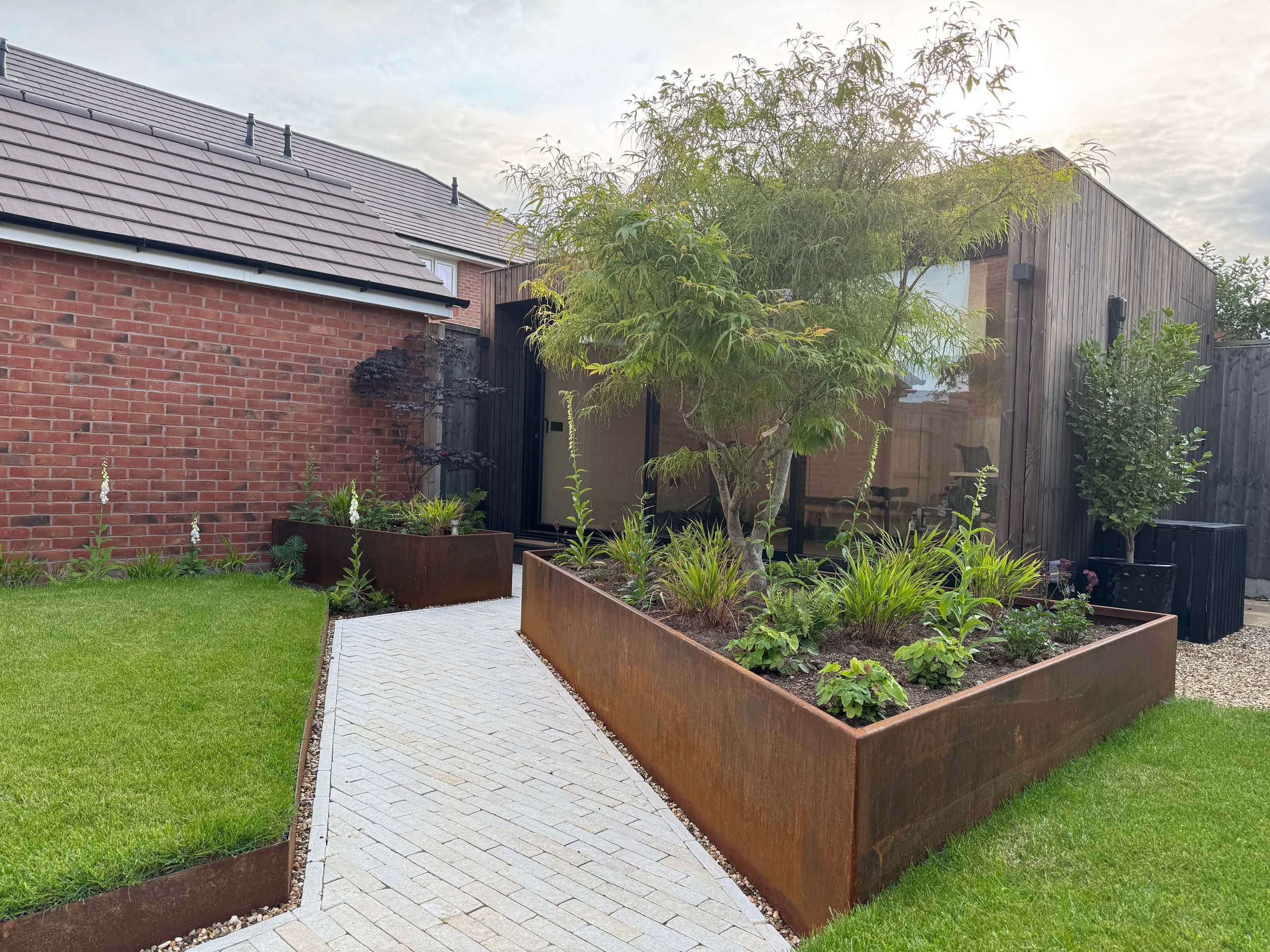
There’s a point in many gardens where everything is visible at once.
You step outside and take it all in immediately. The lawn, the terrace, the planting, the boundary. Nothing is hidden, nothing unfolds. It’s all there, laid out in front of you.
Some people find comfort in that openness. Others sense something missing, even if they can’t quite name it. A lack of depth. A feeling that the garden is a single space rather than a sequence of places.
This is where zoning begins
Garden zoning is about creating rhythm and progression. About allowing the garden to reveal itself gradually rather than all at once. Done well, it gives a garden intimacy without enclosure, structure without walls.
It changes how you move through the space, and how long you choose to stay.
When we talk about rooms in a garden, we’re not talking about fixed boundaries or hard edges. We’re talking about subtle shifts. A change in planting density. A turn in a path. A tree that interrupts a long view. A bench placed just out of sight, discovered rather than announced.
These moments don’t separate the garden, they connect it.
A garden made up of zones feels larger than it is. When you can’t see everything at once, your mind fills in the gaps. Curiosity pulls you forward. Each area holds its own atmosphere, even if the materials remain consistent throughout.
This is something buildings have always understood. You don’t enter a home and see every room immediately. You move through thresholds. Hallways. Corners. Each space has a purpose, a scale, a mood. Gardens deserve the same consideration.
Often, zoning begins with how the garden is used
Where do you arrive?
Where do you pause?
Where do you want to sit, walk, gather, retreat?
These questions are more important than shape or style. A quiet corner for morning coffee needs a different feeling to a space designed for long summer evenings with friends. A route to the shed or compost heap doesn’t need the same attention as a place you pass through slowly.
Once those patterns are understood, the zones start to suggest themselves.
Planting does much of the work here. A low hedge can suggest a boundary without blocking light. Tall grasses can screen just enough to create separation while still allowing movement and sound to pass through. Shrubs placed at angles rather than in straight lines soften transitions and slow the pace.
Trees are particularly powerful in this role. A single tree can divide space simply by occupying it. You walk around it, not through it. It becomes a marker, a pause, a moment of orientation. Groups of trees can create canopy rooms beneath them, spaces that feel sheltered without being closed.
Hard materials support this language when used carefully. A change in surface underfoot can signal a shift in function. Gravel slows you down. Stone invites stillness. Timber decking suggests warmth and gathering. These transitions don’t need to be dramatic to be effective. Often the quietest ones are the most enduring.
What zoning avoids is the need for overt control
Instead of fencing off areas or dictating use, it allows choice. You might pass through a space one day and linger there the next. The garden adapts to mood, weather, season. The same place can feel expansive in summer and intimate in winter, simply through planting growth and light.
Children understand this instinctively. They don’t need labels for spaces. They respond to enclosure, hiding places, routes and landmarks. A hedge becomes a boundary to race along. A gap between shrubs becomes a doorway. A fallen log becomes a seat, then a balance beam, then a ship.
Zoned gardens give permission for this kind of exploration.
There’s also a practical generosity in zoning. Smaller areas are easier to care for. Planting can be tailored more precisely to conditions. A damp corner becomes a place for moisture-loving plants rather than a problem to be solved. A sunny edge becomes productive, or simply comfortable.
In larger gardens, zoning helps manage scale. Without it, space can feel overwhelming, undefined. Breaking the garden into a series of connected places makes it more legible, more human. You relate to it step by step rather than all at once.
This approach also allows gardens to evolve
Zones don’t need to be finished at the same time. One area can mature while another remains loose or temporary. This reduces pressure. It acknowledges that gardens change, and that design doesn’t have to resolve everything immediately.
In fact, some of the most successful gardens are those that leave room for adjustment. A path that could extend. A planted area that might one day become somewhere to sit. A view that might be framed more tightly as trees grow.
Zoning gives structure without finality.
What we’re often trying to avoid is the sense of a garden as a single, flat gesture. One idea applied everywhere. Uniformity might feel tidy, but it rarely feels alive. Variety, when held together by a clear framework, is what gives gardens depth and longevity.
This doesn’t mean every zone needs a different style. Consistency of materials and planting palette is often what makes zoning work. It’s the arrangement that changes, not the language. Like chapters in the same book, each space has its own focus while belonging to the whole.
Over time, these zones gather meaning
The corner where you always sit in late afternoon light. The path that catches frost first. The place where the dog waits while you open the shed. The garden becomes a collection of remembered moments as much as designed ones.
This is something open-plan gardens often struggle to achieve. Without variation, memory has fewer hooks to hang on to.
When we design with zones, we’re thinking beyond aesthetics. We’re shaping how a garden is lived in, moved through, remembered. We’re allowing it to hold different versions of daily life without forcing them into a single space.
No walls are required for this. Just attention. Careful placement. An understanding of how people and plants share space.
When zoning is right, the garden feels generous rather than divided. It offers choice rather than instruction. It becomes a sequence of experiences, each one quietly connected to the next.
Not rooms to be closed off, but places to belong to.
You can learn about more gardening terminology in our complete guide.
Want to create rooms without walls in your garden?
If you’re thinking about how zoning could shape your garden, we’d love to hear about your project.
Umber Garden Design creates thoughtfully crafted garden designs across Warwickshire, blending considered garden design with skilled landscaping and planting that matures beautifully over time.
Get in touch to start a conversation and explore what your garden could become.