
Annuals in the Garden: What They Are and How to Use Them Well
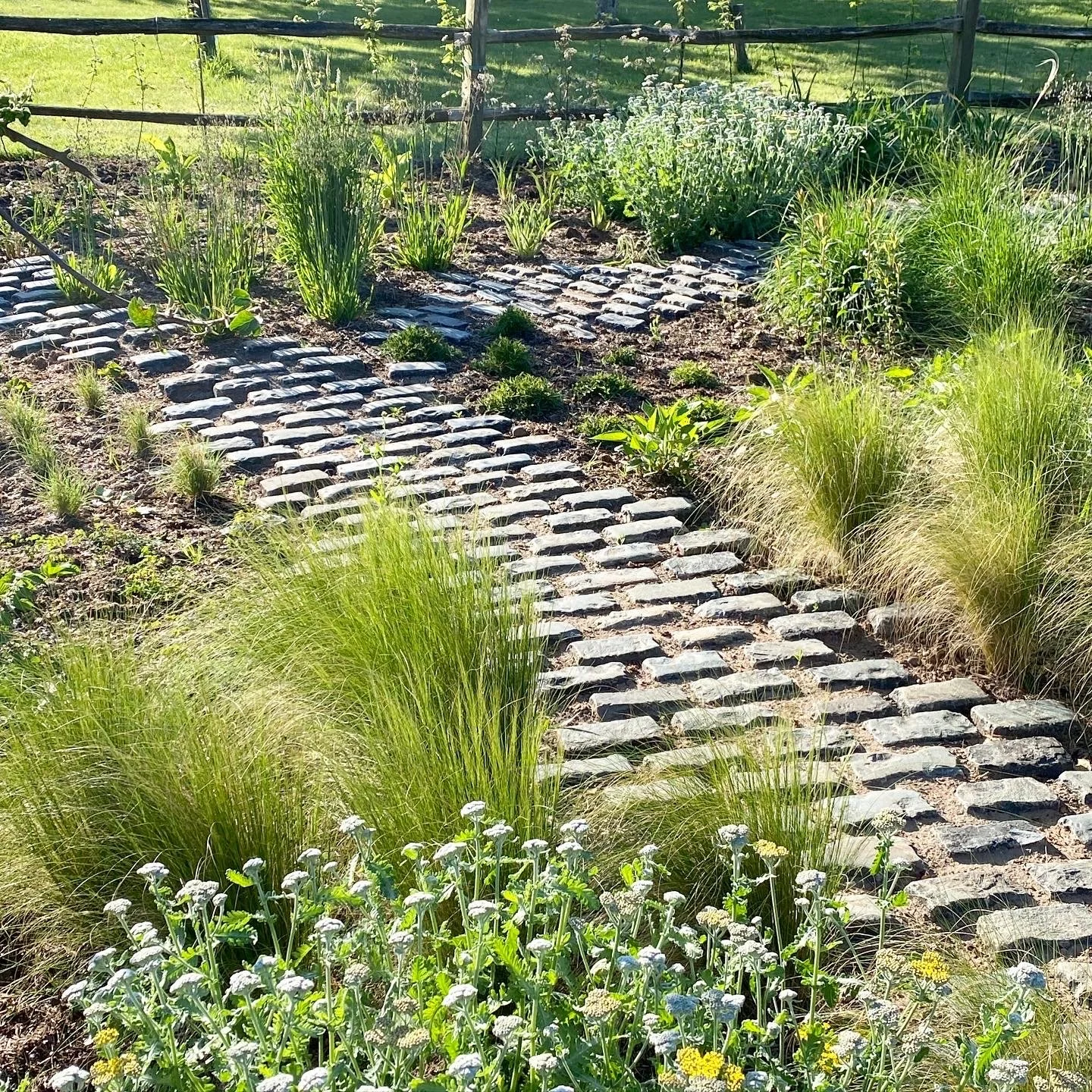
Annual plants complete their entire life cycle within a single growing season. They germinate, flower, set seed and die within one year. That gives them a distinct role in the garden compared to perennials or shrubs.
In this article, we'll explore what makes annuals useful in garden design. You’ll learn about the difference between hardy and half-hardy types, how to incorporate them effectively alongside permanent planting and how to manage them through the season.
What makes a plant an annual?
An annual completes its life cycle in one year. It germinates from seed, grows, flowers, produces seed and dies, all within a single season. This is the plant's entire reproductive strategy: invest everything in flowering and seed production, rather than building the kind of root structure or woody framework that allows a perennial to return year after year.
Some plants described as annuals in British gardens are technically tender perennials, meaning they can live for several years in warm climates but won't survive a UK winter. Cosmos, Nicotiana and Pelargonium all fall into this category. For practical purposes in garden design, they're treated as annuals because they need to be raised fresh each year.
Hardy and half-hardy annuals
Understanding the difference between hardy and half-hardy annuals is important when planning what to grow and when to sow.
Hardy annuals
Hardy annuals can withstand frost. Many can be sown directly into the ground in autumn or early spring and will germinate and establish without protection. Common examples include:
Nigella damascena (love-in-a-mist)
Calendula officinalis
Centaurea cyanus (cornflower)
Eschscholzia californica (California poppy)
Papaver rhoeas (field poppy)
These tend to be among the easiest annuals to grow because they require little intervention: sow, thin and allow to flower.
Hardy annuals often self-seed, which means they can reappear year after year without being replanted, once established in a garden. This makes them particularly useful in naturalistic planting schemes where spontaneity is welcome.
Half-hardy annuals
If you're unsure whether the moment is right for a particular crop or flower, our What to Plant Now tool shows what's worth sowing or planting in a UK garden each month. Cosmos bipinnatus, Zinnia elegans, Antirrhinum majus and Tagetes all belong to this group. They require a little more planning and handling but reward that effort with a long flowering season that runs well into autumn.
The role of annuals in garden design
Annuals are often treated as fillers. Plants chosen to plug gaps while the permanent structure establishes. That's a narrow view of what they can do.
In a newly planted garden, annuals are genuinely useful for covering bare ground quickly. A border filled with young shrubs and perennials can take two or three years to knit together. Annuals bridge that gap and prevent the garden from looking sparse or allowing weeds to colonise open soil.
Nigella, Ammi majus and Phacelia tanacetifolia all do this well. Put simply, they fill space with something worthwhile rather than something merely occupying ground.
But annuals also have a place in an established garden. They introduce a level of flexibility that permanent planting can't offer. You could:
Change the colour mood of a border from one year to the next simply by choosing different annuals
Trial combinations before committing to permanent plants
Respond to seasonal conditions or a client's changing preferences without lifting and replanting established structure
Some garden designers use annuals explicitly to support wildlife. Phacelia tanacetifolia is one of the most effective plants for pollinators, producing a dense mass of flower that bees work heavily through summer. Calendula and Echinacea purpurea (technically a perennial, but worth noting for comparison) offer accessible pollen and nectar across a long season.
At Umber Garden Design, we consider pollinator value as part of planting decisions at every scale. Annuals are a straightforward way to increase that value without permanent commitment.
Annuals in naturalistic and cottage planting
Naturalistic planting schemes aim to replicate the visual character of wild plant communities. And they use annuals extensively. The meadow aesthetic that has become increasingly popular in British garden design relies heavily on annual species.
Corn poppies, cornflowers, ox-eye daisies and corn marigolds were once common across British farmland and carry a strong sense of place. A sown meadow mix using these species can establish quickly and deliver colour within a few months of sowing.
Cottage garden planting also makes consistent use of annuals. Consider the characteristic informality of a cottage border, where plants seem to have arrived of their own accord. This is produced, in part, by annuals seeding into gaps and self-distributing in ways that no designer could have fully planned.
The slightly accidental quality is precisely the point. Allowing hardy annuals to seed around is one of the simplest ways to soften the edge between design and nature.
Managing annuals through the season
Annuals need relatively straightforward management once they're in the ground. The key is timing.
Thinning
For hardy annuals sown in autumn, the main task is thinning. Over-crowded plants compete for light and air, which weakens flowering. Thin to the spacing recommended on the packet and resist the urge to leave everything in place.
Hardening off
For half-hardy annuals started under cover, hardening off is essential. Plants raised in a greenhouse or on a windowsill need a period of acclimatisation before being planted outside. Rushing this step causes plants to go into shock, and growth stalls badly. For best results, spend ten to fourteen days moving them outside during the day and back under cover at night before final planting.
Deadheading
Deadheading extends the flowering season for most annuals. Once a plant sets seed, its primary biological objective is complete and flowering slows or stops. Regular deadheading encourages continued flower production. For plants being grown partly for their seed heads, such as Nigella, you can stop deadheading in late summer and allow the pods to develop. These are genuinely attractive through autumn and provide seed for the following year.
Watering
Watering is critical during establishment. Once established, many annuals are surprisingly drought-tolerant, particularly the Mediterranean and prairie-origin species. Overwatering encourages leafy growth at the expense of flowers.
Annuals through the year
Annuals tend to be thought of as a summer proposition, but the season can be extended at both ends with careful selection.
The same autumn window is the moment for most spring bulbs, and our Bulb Planting Timer shows the right planting time, depth and flowering month for each one. Nigella and Calendula both behave this way and will be in flower by May if autumn-sown.
Into late summer and autumn, half-hardy annuals such as Cosmos, Zinnia and Tithonia rotundifolia come into their own. These plants flower at their best as the days shorten and temperatures drop slightly in August and September, often continuing to flower well past the first light frosts.
The warm tones of late-season annuals (amber, copper and rust) are well-suited to early autumn light and work naturally alongside the changing colour of deciduous shrubs and grasses.
You can learn about more gardening terminology in our complete guide.
Ready to think about planting in more depth?
Annuals offer flexibility, seasonal colour and genuine ecological value, but they work best when they're chosen and placed as part of a considered planting design rather than added as an afterthought. At Umber Garden Design, planting is central to how we approach every project, from the initial design through to the detailed plan and long-term care.
Whether you're working with an established garden that needs more seasonal interest or starting from scratch on a new project, we'll work with you to develop planting that suits the site, the season and the long-term character of the space. Contact us today to arrange a consultation.