
Garden Design Terminology: Your Go-To Guide for Lingo
At Umber Garden Design, we believe that the best gardens emerge from genuine collaboration between designer and client. Understanding the terminology is a small but meaningful part of that.
Whether you’re embarking on a full garden transformation or commissioning a planting scheme for the first time, knowing the language used in professional garden design helps you ask better questions, make more confident decisions and arrive at a result that truly feels like yours.
This guide covers the key terms you’re likely to encounter when working with a professional garden designer. We’ve organised it to follow the journey of a typical garden project, from the first site visit through to planting and long-term care. There’s also a quick-reference glossary at the end for short, sweet definitions.
Contents:
The design process: from site to concept
Every garden project begins with close observation. A professional garden designer will spend time understanding the place before proposing any solutions for it.
Site and site analysis
The site simply refers to the plot of land being designed. Site analysis is the process of studying it. So, mapping its boundaries, levels, soil type, drainage, sun exposure, wind direction and existing features. Good site analysis underpins every decision that follows.
Site survey
A site survey is a formal, measured record of the garden. That includes its dimensions, levels, the position of trees and structures, and the location of drains, manholes and service runs. It provides the accurate base plan that all subsequent design drawings are built upon.
Orientation
Orientation describes the direction in which the garden faces relative to the sun. South-facing gardens get lots of direct sunlight, while north-facing ones may be largely in shade. This shapes decisions about seating areas and which plants will thrive.
Microclimate
A microclimate is the localised set of conditions that prevail in a specific area of the garden. Think warmer vs cooler or more sheltered vs more exposed than the surrounding land:
South-facing walls create warm microclimates ideal for tender plants
A dip in ground level can collect frost
A gap between buildings may funnel wind
Concept plan
A concept plan is an early, exploratory drawing that captures the key ideas for the garden without committing to precise dimensions or details. It might show the broad footprint of a terrace, the rough location of planting areas or a proposed circulation route. Its purpose is to test ideas and invite conversation.
Master plan
A master plan is the comprehensive, scaled drawing that shows the complete design for the garden. It includes all hard and soft elements in their correct proportions and positions. For larger gardens or phased projects, the master plan acts as the long-term vision, even if not all elements are delivered at once.
Design objectives
Design objectives are the agreed goals for the project. They might include creating privacy, providing outdoor dining space, improving drainage, making the garden more wildlife-friendly or reducing maintenance.
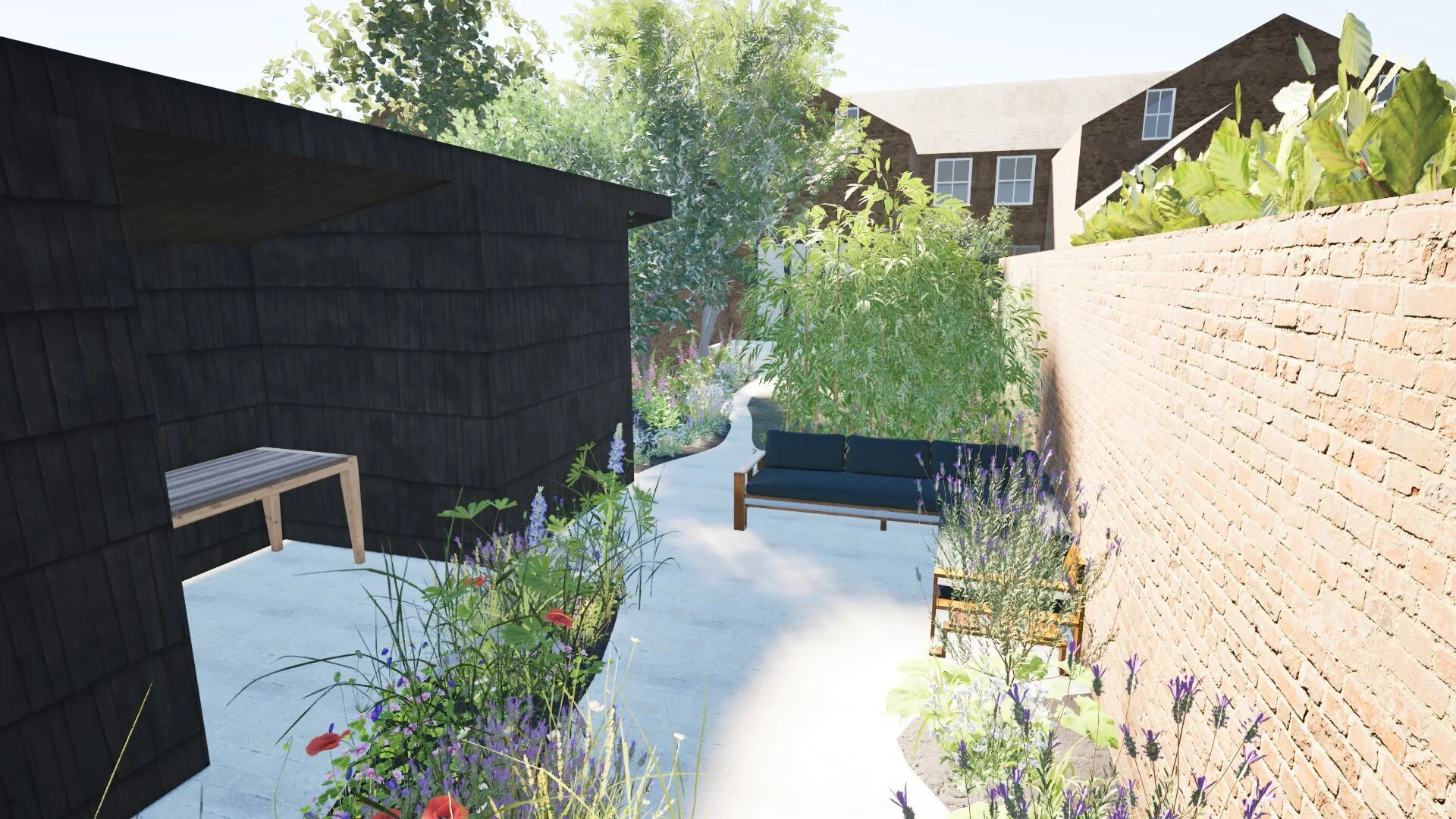
Rendering and 3D visualisation
A rendering (or 3D visualisation) is a lifelike image of the proposed garden created using specialist software. It allows you to see how the finished space might look before a single sod has been lifted.
Design principles: the foundations of visual thinking
Professional garden designers apply a set of visual and spatial principles that have their roots in fine art, architecture and landscape design.
Balance
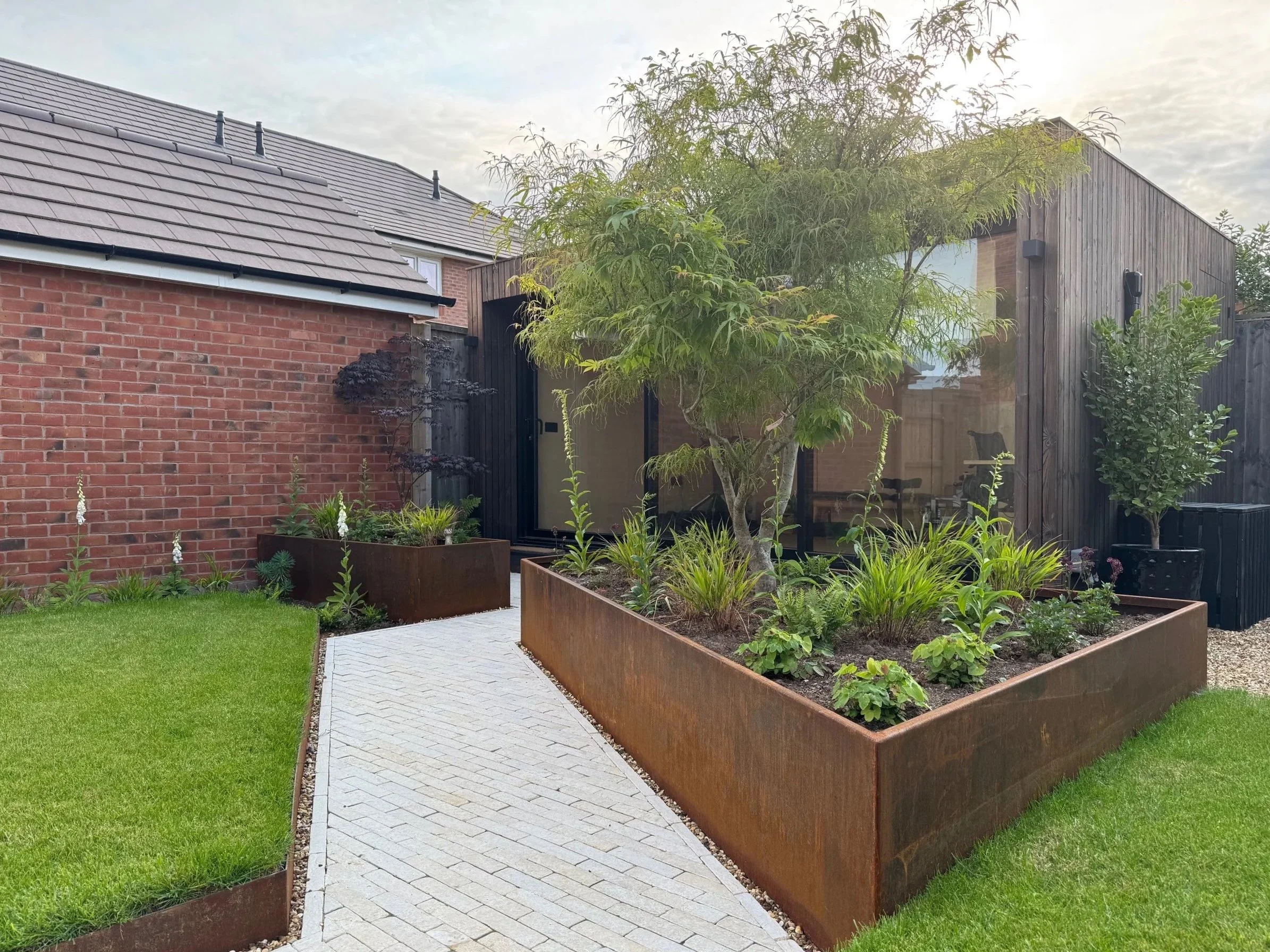
Balance refers to elements being distributed in a way that feels stable and considered.
Symmetrical balance places matching elements on either side of a central axis.
Asymmetrical balance achieves the same calm feeling through the careful arrangement of different elements.
Contrast
Contrast is the deliberate use of difference (colour, texture, form or scale) to create visual interest and make individual elements stand out. Without contrast, a garden can feel flat. Too much contrast, and it becomes restless.
Garden focal point
A focal point is a feature that draws the eye and anchors the design. In a well-designed garden, focal points give the eye somewhere to rest and the mind somewhere to go.
Scale
Scale describes the size relationship between elements (plants, structures, furniture and the garden itself). It’s also used technically to describe the ratio of a drawing to the real-world space it represents.
Axis and sightline
An axis is an imaginary line that organises a garden. It usually runs from a significant point in the house (a back door or bay window) towards a focal point or boundary feature. Sightlines are the views along or across these axes, which are particularly important in family gardens.
Garden rooms and garden zoning
Garden rooms are distinct areas within a garden, each with its own purpose, character or planting palette. Garden zoning is the act of dividing a space into these areas, often using changes in level, planting screens, lighting (such as downlighting), hedging or path alignment.
Enclosure
Enclosure is the sense of containment that gives a garden (or a part of it) a feeling of intimacy and shelter. It can be created by walls, fencing, hedging, planting or a combination of all four.
Softscaping
Softscaping refers collectively to all the living, planted elements of a garden (as opposed to the hard, structural materials). Whilst the term is sometimes used loosely to mean simply 'planting', it more accurately describes the sum of all organic components: trees, shrubs, perennials, bulbs, lawns, groundcover and climbers.
Garden styles: finding a language for your space
Gardens are as varied as the people who make them, but certain broad styles have emerged over centuries of design practice.

Formal design
Formal gardens are defined by geometry, symmetry and strong structural lines, with deep roots in European garden history. Clipped hedges, straight paths, paired plantings and clearly ordered spaces are characteristic.
Informal design
Informal gardens favour curves, asymmetry and a sense of relaxed naturalism. Paths meander, planting spills generously and edges are soft rather than crisp. Crucially, informal design doesn’t mean undesigned.
Contemporary and modernist garden design
Contemporary (or modernist) garden design is characterised by clean lines, bold structural forms and a restrained palette. It tends to draw on architecture, creating a strong visual connection between house and garden.
Naturalistic design
Naturalistic planting and design takes cues from meadows, woodland edges and prairie grasslands. Naturalistic designers work with drifts, layered planting and self-seeding to gardens that mimic the wild.
Cottage garden
The cottage garden is one of Britain's most beloved and enduring styles. An abundant, seemingly artless combination of flowers, herbs, climbers and edibles. Its appeal lies in the sense of overflowing generosity, in contrast to a minimalist garden.
Sustainable garden
A sustainable garden is designed to tread lightly on the environment by:
Using water wisely
Supporting wildlife
Choosing materials responsibly
Reducing the need for chemicals or excessive maintenance.
Other styles worth knowing
Beyond the styles above, you may also encounter the following terms when exploring garden design ideas:
Mediterranean garden – Warm, drought-tolerant planting in gravels and terracotta. Suited to sunny, sheltered sites.
Woodland garden – Shade-tolerant planting beneath a canopy of trees. Ferns, hostas and spring bulbs.
Wildlife garden – Designed primarily to support birds, insects and other wildlife through habitat and food sources.
Prairie-style planting – Inspired by North American grasslands. Characterised by ornamental grasses interwoven with late-flowering perennials.
Hard landscaping: structure, materials and build
Hard landscaping refers to the non-living, structural elements of a garden: paths, patios, walls, steps, decking and the groundwork that supports them.
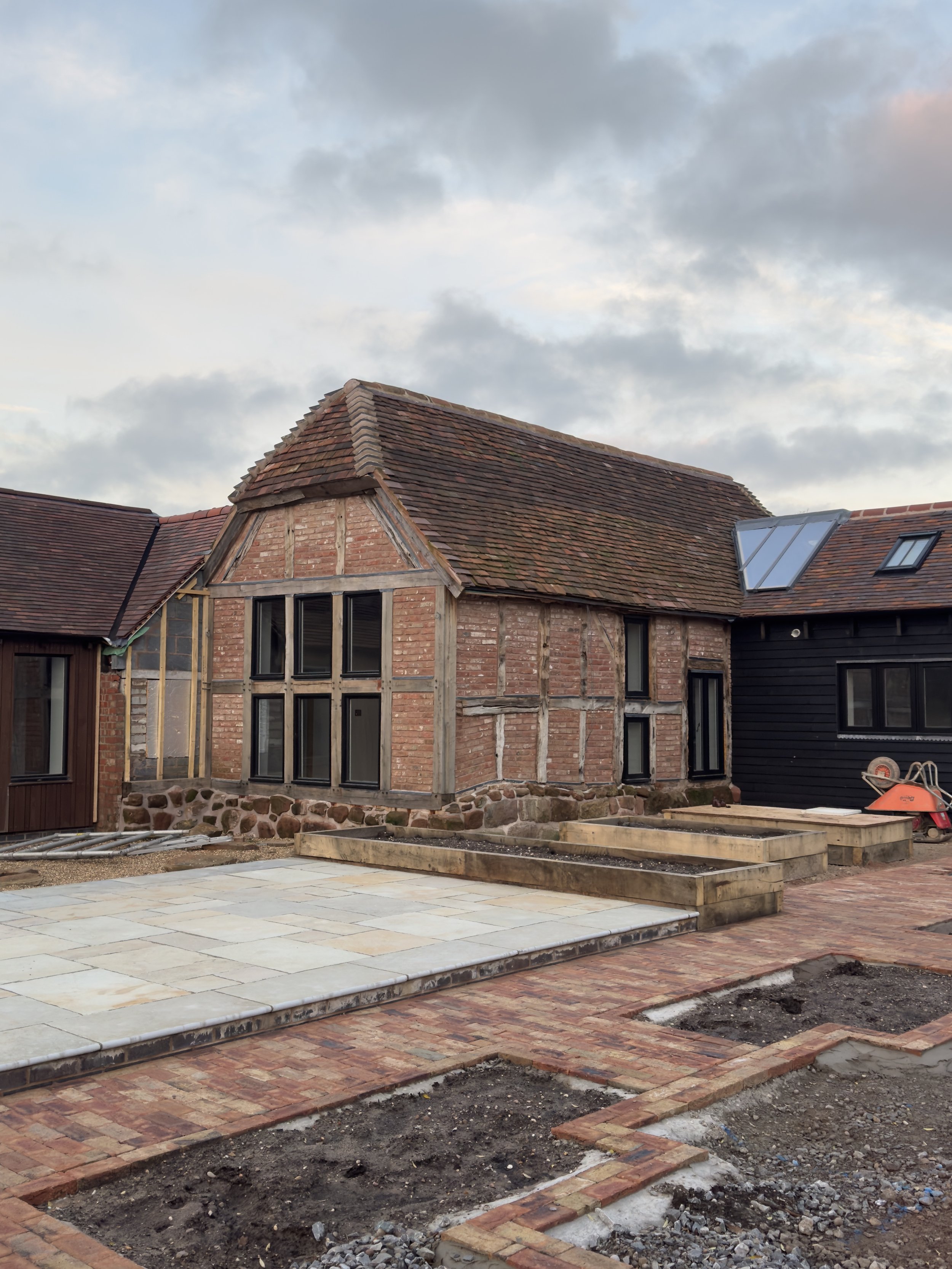
Hardscaping
Hardscaping is the collective term for all the hard, structural elements in a garden. Think paving, decking, walls, steps, edging, pergolas and other built features. The quality and character of hardscaping sets the tone for the whole garden.
Paving, pavers and patios
Paving refers broadly to any hard surface laid at ground level, whether it’s stone, porcelain, brick or concrete.
Pavers are the individual units used to create paving.
A patio is a paved area adjacent to the house used for outdoor sitting and dining.
Decking and composite decking
Decking is a raised or ground-level surface made from boards, traditionally of hardwood or treated softwood. Composite decking blends wood fibre and recycled plastic for better durability and reduced maintenance.
Retaining walls, terracing and raised beds
A retaining wall holds back soil or creates a level change in the garden, with backfill playing an important role.
Terracing involves creating a series of level platforms on a slope, often using retaining walls.
Raised beds are framed planting areas elevated above the surrounding ground level, typically constructed in timber, stone or steel.
Groundworks and sub-base
Groundworks are all the preparatory earthworks carried out before construction begins. That includes excavation, levelling, drainage installation and the laying of foundation layers.
The sub-base is the compacted aggregate layer (typically MOT Type 1 crushed stone) that sits beneath paving, providing a stable, free-draining foundation.
Edging
Edging defines the boundary between different surfaces or between hard and soft elements. It keeps gravel out of lawns (especially pea gravel) and paving away from planted borders.
Garden structures
Garden structures include all the built elements above ground level, such as pergolas, arbours and even gazebos.
Permeable paving and SuDS
Permeable paving allows rainwater to pass through the surface and into the ground beneath, rather than running off into drains. This approach forms part of a broader strategy known as SuDS (Sustainable Drainage Systems), which manages surface water in a way that mimics natural processes.
Planting: Structure, layers and seasonal life
Planting is where a garden finds its voice. These are the key terms that describe professional planting practice.
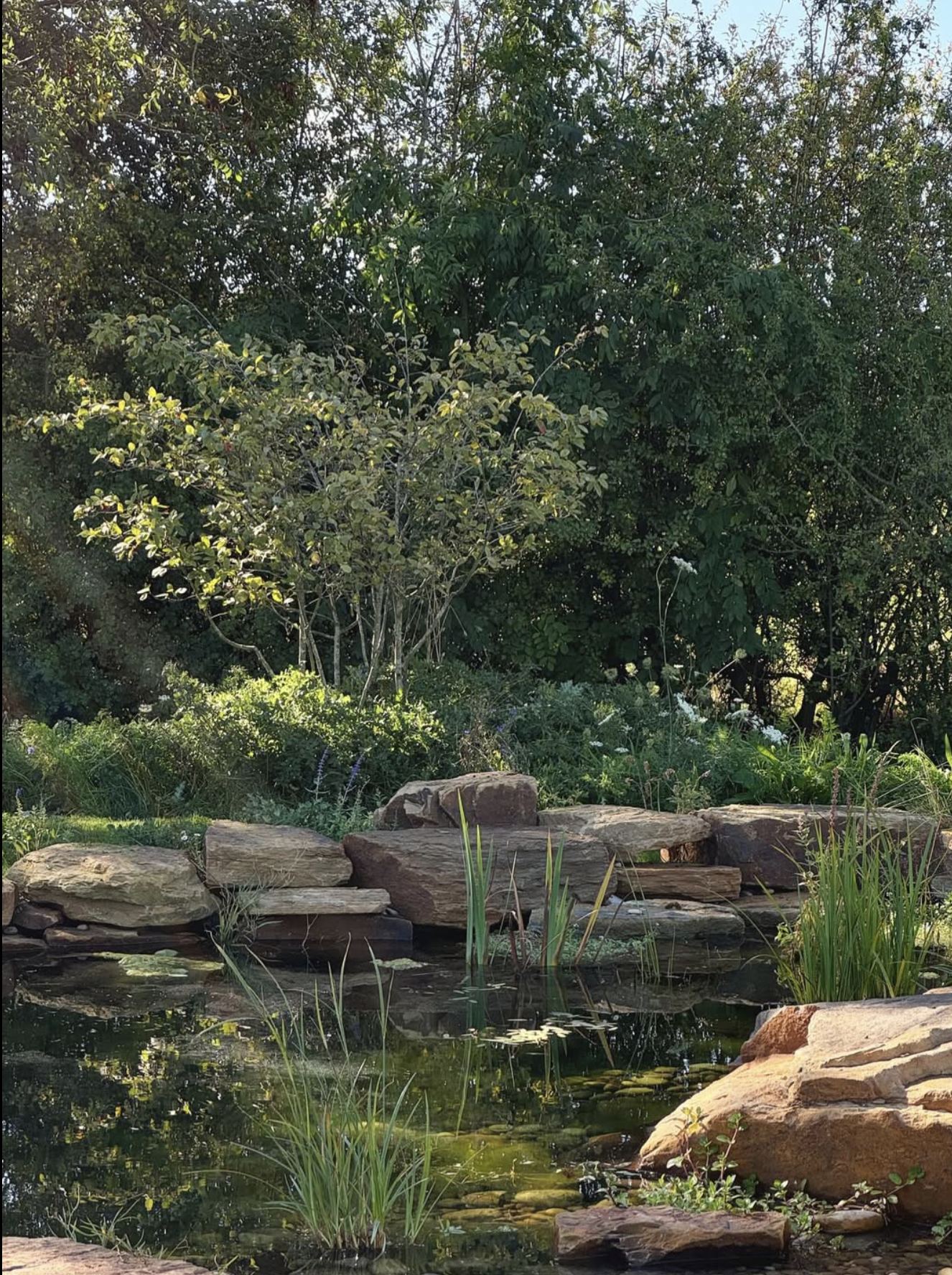
Structural planting
Structural planting refers to the plants that provide the garden's permanent framework. Your evergreen hedges, shaped topiary, multi-stemmed trees and large architectural shrubs. These are the elements that give a garden its form in winter, when everything else has died back.
Layer planting
Layer planting describes the practice of using plants at multiple heights to create depth and ecological richness. There’s typically a canopy layer (trees), a sub-canopy or shrub layer, a perennial or herbaceous layer, and a groundcover layer.
Planting schemes
A planting scheme is the planned selection and placement of plants (including accents) for a specific area. It considers colour, form, texture, season of interest and cultural requirements.
Seasonal interest
Seasonal interest means keeping something worthwhile in your garden across all four seasons. Think spring bulbs, summer flowers, autumn colour and berries, and winter structure and bark.
Palette and plant palette
The plant palette is the chosen set of species used in a scheme. A well-edited palette has coherence with plants that belong together tonally, ecologically and visually.
Key plant types
Understanding the basic categories of plants is helpful when discussing a planting scheme:
Perennials – Plants that live for more than two years, dying back in winter and returning in spring. Hardy perennials are fully frost-tolerant.
Annuals and biennials – Annuals complete their life cycle in one year; biennials take two. Both provide seasonal colour but require more active management.
Shrubs – Woody plants that branch from near the base; the backbone of many planting schemes.
Evergreen vs deciduous – Evergreens retain their leaves year-round and provide winter structure. Deciduous plants shed their leaves, often offering autumn colour before they do.
Bulbs, corms and tubers – Underground storage organs from which seasonal plants emerge; snowdrops, tulips, alliums and dahlias are all examples.
Climbers – Plants that use walls, fences or structures to reach height; invaluable for adding vertical interest and softening hard surfaces.
Ornamental grasses – Prized for their movement, texture and extended season; central to naturalistic and prairie-style planting.
Specimen plant – A plant grown or placed to be admired as an individual, usually for its form, scale or rarity.
Topiary and espalier
Topiary is the art of training and clipping plants into defined shapes like spheres, cones, clouds or spirals. Espalier is a related technique, where you train trees flat against a wall or framework.
Propagation and transplanting
Propagation is the process of creating new plants by seed, cuttings, division or layering.
Transplanting is the act of moving a plant from one location to another.
Additionally, transplant shock is the stress response that can follow, caused by root disturbance.
Sustainability and ecology: designing with nature in mind
Contemporary garden design is increasingly shaped by ecological awareness. In short, gardens can do far more than please the eye.
Biodiversity
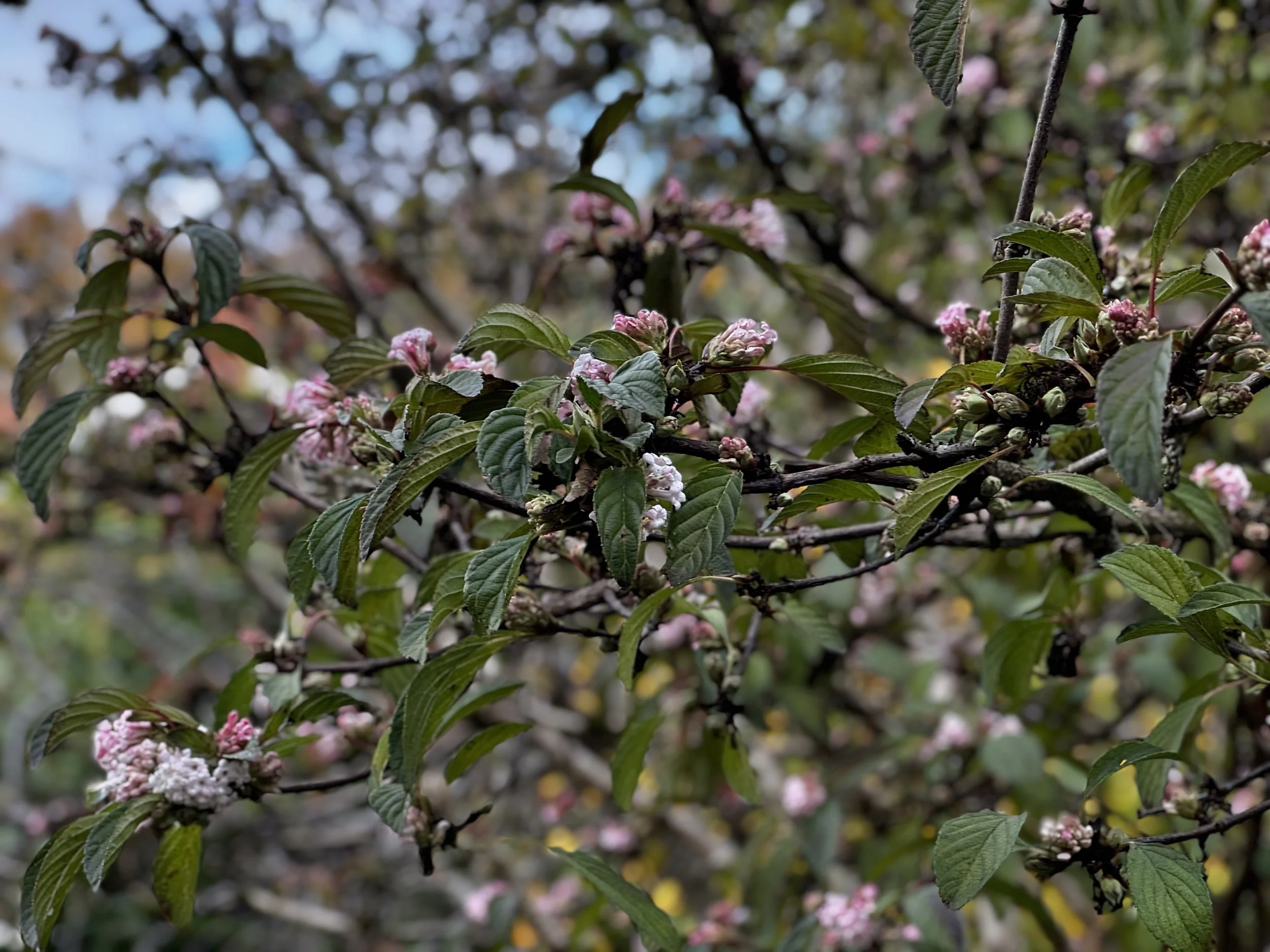
Biodiversity in garden design refers to the range of living organisms that a garden can support. A biodiverse garden is structurally varied, rich in native and wildlife-friendly plants, and provides food, shelter and breeding habitat.
Rewilding
In a domestic context, rewilding means deliberately reducing human intervention to allow natural processes to take over.
Pollinator garden and native planting
A pollinator garden is designed specifically to support bees, butterflies and other pollinating insects through a continuous succession of nectar and pollen-rich flowers. Native planting (using plants indigenous to the UK) is an important part of this, as many specialist insects have co-evolved with specific native plant species.
Drainage and water management
Good drainage is one of the most fundamental requirements of a healthy garden. Key drainage terms include:
Soakaway – A pit filled with rubble into which surface water drains.
French drain – A trench filled with gravel through which water is channelled away.
Rain garden – A shallow depression planted with water-tolerant species that captures and filters surface run-off.
Rill – An ornamental water channel used both aesthetically and to direct water flow through a design.
Soil and growing conditions
Understanding your soil is foundational to choosing the right plants. Key terms include:
pH level – A measure of acidity or alkalinity.
Clay soil – Heavy, moisture-retentive and slow to warm.
Loam – The ideal balance of sand, silt and clay.
Compost – Decomposed organic matter used to improve soil structure.
Mulch – A layer of organic or inorganic material applied to the soil surface to suppress weeds, retain moisture and regulate temperature.
Humus – The dark, stable organic matter produced by the decomposition of plant material.
People and roles: who does what in garden design?
The garden design industry uses several professional titles, and it’s worth understanding the distinctions.
Garden designer
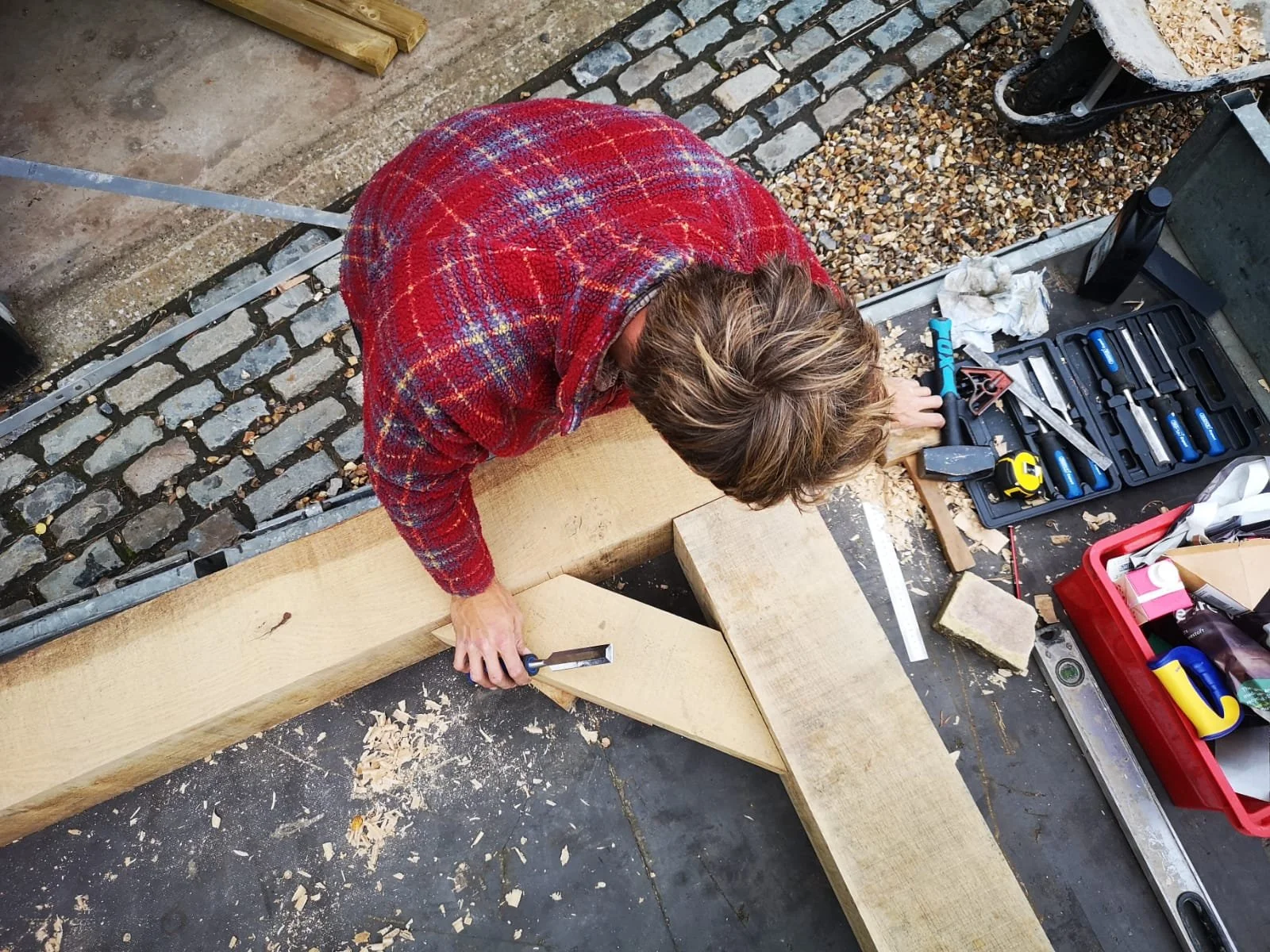
A garden designer creates detailed plans and planting schemes for domestic and commercial outdoor spaces. Anyone can use this term in the UK, but reputable designers typically hold qualifications from the Society of Garden Designers (SGD), the Royal Horticultural Society (RHS) or a specialist college.
Landscape architect
A landscape architect is a qualified professional (typically holding a degree and chartered status with the Landscape Institute) who works across a broader range of scales and project types. This title is regulated in the UK.
Landscape designer
Landscape designer is sometimes used interchangeably with garden designer, but can also describe professionals who work across a broader range of project types and scales. The term is not regulated.
Arborist
An arborist is a specialist in the care, management and surgery of trees. Where a garden design project involves significant existing trees, an arborist's report may be required, particularly when planning permission, conservation areas or Tree Preservation Orders are involved.
Working with Umber: design rooted in place
At Umber Garden Design, we work with homeowners across Warwickshire and the surrounding counties to create gardens that are thoughtfully designed, carefully built and genuinely connected to the land they occupy. Every project begins with close attention to the site, the light and the way you want to live. Then it unfolds through a process of careful design, honest conversation and skilled construction.
Whether you’re just starting to think about your garden or you have a clear brief already forming, we’d love to talk. Your garden is a long-term investment in the quality of daily life. Getting the design right from the outset makes everything that follows easier, more beautiful and more enduring.
Get in touch to arrange an initial conversation about your garden.
Quick-reference glossary of garden design terms
The following glossary provides short definitions of the most common garden design and gardening terms you’re likely to encounter.
Access – How you reach or approach an area for maintenance, movement or welcome).
Aesthetics – The overall look and feel of a designed space.
Annuals – Plants that complete their life cycle within a single year.
Arborist – A specialist in tree care, surgery and management.
Arbour – A small garden structure designed as a seating retreat, typically framed by climbing plants.
Axis / sightline – An imaginary line that organises a garden, drawing the eye towards a focal point or view.
Balance – The visual equilibrium of elements in a composition.
Bespoke garden design – A fully tailored design created for a specific site, client and brief.
Biodiversity – The range of species a garden can support through its planting, structure and management.
Bulb – An underground storage organ from which seasonal plants grow.
Climber – A plant that uses walls, fences or structures to reach height.
Composite decking – Durable and low-maintenance boards made from wood fibre and recycled plastic.
Companion planting – Growing plants in proximity to provide mutual benefit, such as pest deterrence or pollination support.
Concept plan – An early exploratory drawing capturing key design ideas without full detail.
Conservation area – A designated area of special architectural or historic interest (additional planning controls apply).
Contour – Shaped changes in ground level such as mounds, swales and terraces.
Contrast – Deliberate differences in colour, form or texture used to create visual interest.
Cottage garden – An informal, abundant style of planting combining flowers, herbs and climbers.
Deciduous – A plant that sheds its leaves seasonally, typically in autumn.
Design objectives – The agreed goals for a project, established early in the design process.
Drainage – The management of water through and across the garden to prevent waterlogging.
Drought tolerance – The ability of a plant to withstand periods of low water availability.
Edging – A defined boundary between different surfaces or between hard and soft elements.
Enclosure – The sense of containment created by walls, hedging, planting or screening.
Ericaceous – Used to describe ‘acid-loving’ plants (and compost) requiring low-pH growing conditions.
Espalier – Training a tree flat against a wall or framework.
Evergreen – A plant that retains its foliage year-round, providing winter structure.
Focal point – A feature that draws the eye and anchors the design.
Formal design – A structured, geometric garden style characterised by symmetry and strong lines.
French drain – A gravel-filled trench used to channel surface water away from a space.
Gabions – Wire baskets filled with stone, used as retaining walls or architectural features.
Garden rooms – Distinct zones within a garden, each with its own purpose or character.
Garden zoning – The practice of dividing a garden into distinct areas using planting, levels or path alignment.
Gazebo – A fully roofed free-standing garden structure.
Groundcover – Low-growing plants used to suppress weeds and clothe the soil surface.
Groundworks – Preparatory earthworks carried out prior to hard landscaping construction.
Hardy perennial – A perennial plant that is fully frost-tolerant in UK conditions.
Hardscape / hardscaping – The structural, non-living elements of a garden.
Hedge – A living boundary created by closely planted shrubs or trees, typically maintained by clipping.
Herbaceous – Non-woody plants that die back to the ground in winter and regrow in spring.
Humus – Dark, stable organic matter in the soil produced by decomposition.
Informal design – A relaxed garden style with curves, asymmetry and a naturalistic feel.
Insect hotel – A constructed habitat providing nesting sites for solitary bees and other beneficial insects.
Irrigation – A system for supplying water to plants, from simple soaker hoses to automated sprinkler systems.
Kerb appeal – The visual attractiveness of a property and its front garden from the street.
Layer planting – Planting in multiple height layers to create depth and ecological richness.
Leaf mould – Partially decomposed leaves used as a soil conditioner or mulch.
Loam – A fertile soil with a balanced mixture of sand, silt and clay.
Low-maintenance garden – A garden designed to require minimal ongoing intervention, using robust materials and self-sufficient plants.
Master plan – The comprehensive, scaled plan showing the complete design for the garden.
Mediterranean garden – A warm, drought-tolerant style suited to sunny sites featuring gravel, terracotta and aromatic planting.
Microclimate – Localised conditions in the garden that differ from the surrounding area.
Modernism / contemporary garden design – A design style characterised by clean lines, restrained palettes and a strong relationship with architecture.
MOT Type 1 – A graded crushed stone aggregate used as sub-base beneath hard paving.
Mulch – A layer of organic or inorganic material applied to the soil to suppress weeds, retain moisture and regulate temperature.
Native plant – A plant indigenous to the UK, often of high wildlife value.
Naturalistic design – A design approach inspired by natural plant communities with drifts, layers and self-seeding.
Ornamental grasses – Grasses grown for their decorative qualities, including movement, texture and extended season.
Orientation – The direction a garden faces relative to the sun.
Outdoor kitchen – A fitted cooking and food preparation area designed for external use.
Pergola – An open overhead structure, typically supporting climbing plants or defining an outdoor room.
Perennials – Plants that live for more than two years.
Permeable paving – Surfacing that allows rainwater to pass through rather than run off.
pH level – A measure of soil acidity or alkalinity on a scale of 0–14 with 7 being neutral.
Planning permission – Formal consent from a local authority required for certain construction works.
Plant palette – The chosen selection of plant species used in a design scheme.
Planting schemes – The planned selection and placement of plants for a specific area.
Pollinator garden – A garden or area designed to support bees, butterflies and other pollinating insects.
Porcelain paving – A durable, low-maintenance paving material fired at high temperature.
Privacy screen – A structure used to block views, reduce noise or create a sense of enclosure.
Propagation – The process of creating new plants from an existing one, by seed, cutting or division.
Pruning – The controlled removal of stems, branches or roots to shape a plant or encourage healthy growth.
Rain garden – A shallow planted depression designed to capture and filter surface run-off.
Raised bed – A framed planting area elevated above the surrounding ground level.
Rendering / 3D visualisation – A lifelike image of the proposed garden created using design software.
Retaining wall – A wall designed to hold back soil and manage level changes.
Rewilding – Reducing human intervention to allow natural processes and biodiversity to increase.
Rill – A narrow, ornamental water channel used to direct water flow through a garden.
Scale – The proportional relationship between elements in the garden. Also the ratio of a drawing to reality.
Seasonal interest – Features or plantings that provide something of value in every season of the year.
Site analysis – A systematic study of the garden's conditions prior to design.
Site survey – A measured, accurate record of the garden used as the base for design drawings.
Soakaway – A rubble-filled pit into which surface water drains.
Softscaping – The collective term for all living, planted elements of the garden.
Specimen plant – A plant grown or placed to be admired individually, for its form or scale.
Steel edging – A crisp, durable edge detail in Corten or mild steel, characteristic of contemporary design.
Structural planting – Plants that provide the garden's permanent framework such as hedges, topiary and trees.
SuDS – Sustainable Drainage Systems that manage water in ways that mimic natural processes.
Sustainable garden – A garden designed to support biodiversity, manage water wisely and tread lightly on the environment.
Topiary – Plants trained and clipped into defined shapes like spheres, cones, spirals and clouds.
Topsoil – The fertile upper layer of soil in which plants root and grow.
Transplant shock – The stress response of a plant following root disturbance during transplanting.
Variegation – Leaves marked with more than one colour.
Water feature – Any designed element involving water.
Wildlife garden – A garden that supports birds, insects and other wildlife.
Woodland garden – A garden designed around shade-tolerant planting beneath a tree canopy.
Year-round garden – A garden that offers interest, structure and beauty across all four seasons.