
From Filler to Foundation: Using Gravel as a Garden's Main Surface
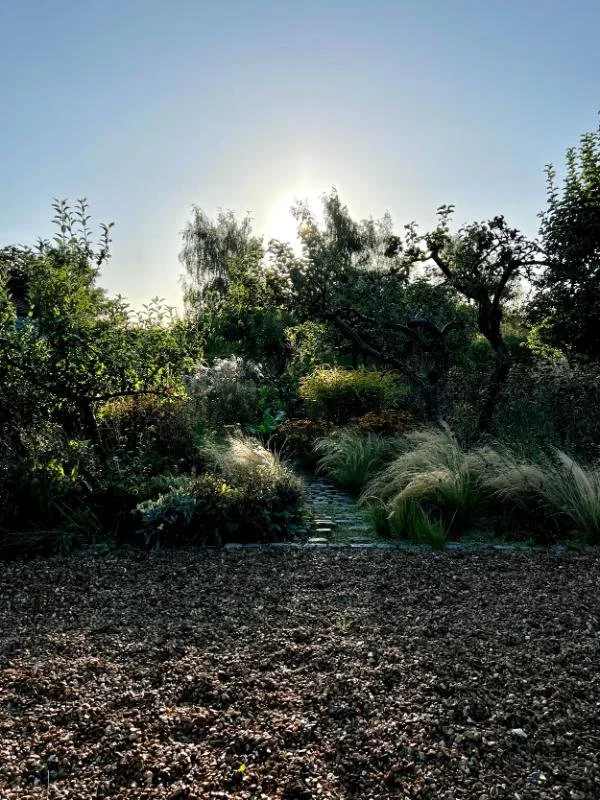
Gravel is usually treated as a supporting material. It’s a path between beds, a mulch around shrubs or a finish for a driveway. But when it’s used as a garden's main surface, it becomes something different. You get a free-draining, low-cost ground plane that plants can grow through directly, rather than a passage between planted areas.
In this article, we'll explore what changes when gravel takes on this main role and the types of gravel best suited to it. We’ll also discuss how it pairs with drought-tolerant planting and what it takes to build and maintain a gravel surface that lasts.
What changes when gravel becomes the main surface
A gravel path sits on a compacted, often membrane-lined base designed purely to bear foot traffic. A gravel surface used as the main ground plane across a bed, courtyard or seating area is built differently, because plants need to establish through it rather than stop at its edges.
That means the base underneath has to support both drainage and root growth, not just structural stability. It also changes how the space reads visually. Instead of a hard boundary between planting and path, gravel used as a main surface blurs that line, so borders feel looser and less formally edged than they would with paving or lawn on either side.
Types of gravel suited to a main surface
Not every gravel is suited to being walked on and planted through in equal measure. The right choice depends on how the surface will be used.
Self-binding gravel
A mix of stone and finer particles that compacts to a firm, relatively smooth surface once laid and rolled. Well suited to paths and seating areas that need a stable, walkable finish, though less permeable than looser gravels.
Pea gravel and rounded aggregates
Loose, rounded stones that drain well and are comfortable underfoot in small doses, though they can migrate underfoot on slopes or heavily used routes and need edging to stay contained.
Angular decorative aggregates
Sharper-edged stone that interlocks more than rounded gravel, giving a firmer, more stable surface that's well suited to planted areas where people won't be walking as frequently.
Pairing gravel with drought-tolerant planting
Gravel's main practical advantage as a surface is drainage. Water passes through it rather than sitting on top, which suits plants that dislike wet roots and struggle in heavier, moisture-retentive soil. This makes gravel surfaces a natural match for drought-tolerant planting, such as:
Mediterranean herbs
Ornamental grasses
Silver-leaved perennials that need sharp drainage more than they need rich soil
Lavender, rosemary, Stipa tenuissima, Euphorbia and Sedum all perform well planted directly into a gravel surface, provided the base beneath has been prepared to drain freely rather than simply topped with stone. Species like Verbena bonariensis and Erigeron karvinskianus will often self-seed into the gravel itself over time, which suits the informal character gravel surfaces tend to encourage.
Related: Planting Schemes: Plants That Belong Together
Building a gravel surface that lasts
The base is what determines whether a gravel surface still looks good in five years or has sunk, weeded through or scattered across the surrounding lawn. Topsoil is typically excavated and replaced with a compacted sub-base of crushed stone, sometimes with a permeable membrane beneath the gravel itself to control weeds. That said, a membrane isn't always used where planting needs to root through into the ground below.
Edging matters as much as the base. Metal, timber or stone edging keeps loose gravel contained and stops it migrating onto lawns or paths over time. Depth matters too: too shallow and the base or membrane shows through, too deep and looser gravels shift underfoot rather than settling into a stable surface.
Cost and maintenance of gravel surfaces
Gravel is generally one of the more affordable main surfaces available, both to install and to maintain. That’s particularly true compared with natural stone paving or composite decking. It doesn't need sealing, staining or the periodic replacement that timber decking eventually requires.
Ongoing maintenance is light but not non-existent. Leaves and debris need clearing so they don't break down into the gravel and encourage weeds, and topping up is occasionally needed where gravel has thinned or migrated. Weeds that do establish are usually easier to pull from gravel than to dig out of soil, since roots have less to grip onto. Over time, a well-maintained gravel surface tends to need less intervention than a comparable lawn or border, especially where drought-tolerant planting is left to self-seed.
You can learn about more gardening terminology in our complete guide.
Want to use gravel as your garden's main surface?
Gravel offers a free-draining, affordable surface that works with drought-tolerant planting rather than against it. At Umber Garden Design, we use gravel as one of the surface options within our garden design and landscaping services, chosen where a site's drainage, planting style and a client's maintenance preferences make it the right fit.
Whether you're replacing a struggling lawn or planning a new courtyard or border from scratch, we'll work closely with you to choose the right gravel and get the base and edging right from the outset. Contact us today to arrange a consultation.