
Decking Materials and Design: A Practical Guide
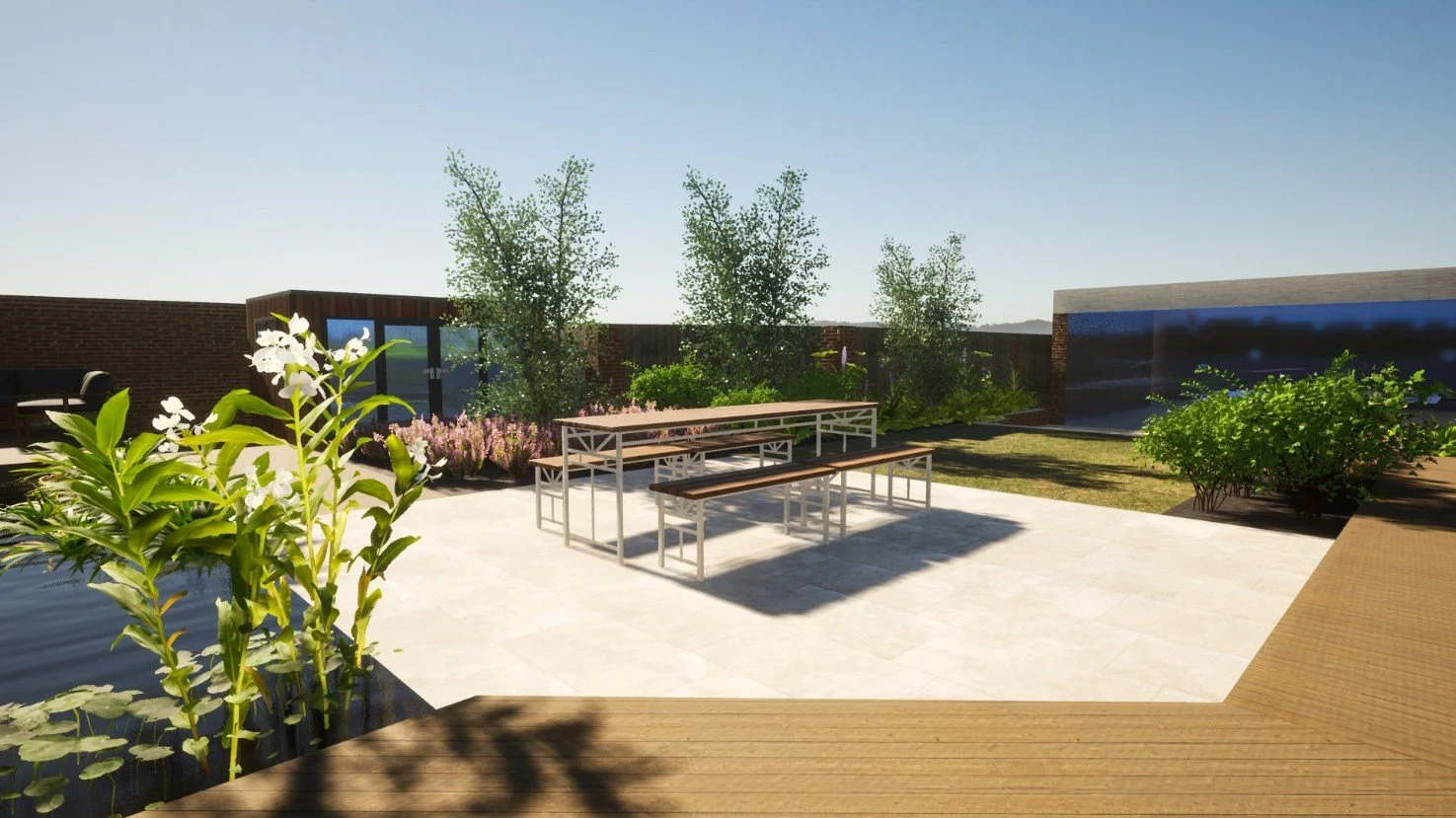
Decking is a surface of boards laid over a subframe to create a raised or level outdoor platform. It's one of the most versatile hard landscaping elements available. It can bridge a level change, extend a house into the garden, create a defined seating area or form part of a larger terrace design. The material the boards are made from has a significant bearing on how the finished surface looks, performs and ages.
In this article, we'll explore the main decking materials available and the design considerations that affect how a deck performs over time. We’ll also discuss how decking relates to other hard landscaping surfaces and what to think about when specifying a deck as part of a wider garden project.
Decking materials: the main options
The choice of decking material affects not just appearance but slip resistance, maintenance requirements, longevity and environmental credentials. The three main categories are softwood timber, hardwood timber and composite decking, each with different characteristics and appropriate applications.
Softwood timber
Softwood decking, typically pressure-treated pine or larch, is the most widely used and least expensive option. Pressure treatment with preservative extends its service life considerably, making it resistant to rot and insect damage. Larch in particular weathers attractively to a silver-grey if left untreated, and is harder and more durable than pine.
The main limitation of softwood is maintenance. Without regular oiling or staining, the surface can dry out, crack and splinter over time. Most softwood decks need treatment every one to two years to maintain their appearance and extend their lifespan. On a large deck, this is a meaningful time and material commitment.
Hardwood timber
Hardwood decking comes from species such as Ipe, Garapa, Cumaru or Accoy. It offers considerably greater durability and density than softwood with a well-maintained hardwood deck lasting thirty years or more. The surface is harder underfoot, more resistant to surface damage and typically more dimensionally stable, meaning it's less prone to warping or splitting as moisture levels change.
The environmental picture for tropical hardwoods is mixed. FSC-certified timber sourced from sustainably managed forests is available and worth specifying, but the supply chain isn’t always easy to verify. Accoya is an exception. It's produced from fast-growing, sustainably sourced softwood that has been acetylated (chemically modified) to achieve hardwood-equivalent durability. It's a strong option where both performance and environmental credentials are priorities.
Hardwood decking requires less frequent maintenance than softwood but isn't maintenance-free. Annual oiling keeps the surface in good condition and prevents the greying that occurs when hardwoods are left unprotected.
Composite decking
Composite decking is manufactured from a blend of wood fibre and recycled plastic. It's designed to replicate the appearance of timber while eliminating most of the maintenance requirements. Composite boards don't rot, splinter or require oiling, and most manufacturers offer long warranties, typically twenty-five years or more.
The quality range within composite decking is wide. Lower-end products can look plastic, fade unevenly in UV light and feel hollow underfoot. Higher-specification composites, from manufacturers such as Millboard, Trex or Cladco, are considerably more convincing in appearance and substantially more durable. Specifying on price alone is a false economy. Put simply a poorly chosen composite deck looks worse over time, not better.
Composite decking is heavier than timber and requires a robust subframe. It's also warmer underfoot in summer, which can be an advantage or a discomfort depending on context and climate.
Design considerations
The material choice matters, but the design of the deck as a whole has an equal bearing on how well it works. That includes its dimensions, orientation, board direction and relationship to the house and garden.
Direction
Board direction is one of the most visually significant decisions. Boards laid parallel to the house draw the eye outward and make a space feel longer. Boards laid perpendicular to the house read as a distinct platform and can feel more contained. Diagonal board layouts add visual interest but increase waste and cost. Where the deck turns a corner or changes level, the board direction can be used to articulate the change and give each area its own character.
Gaps
The gap between boards affects both appearance and drainage. Too small a gap and water sits on the surface. Too large and the deck feels uneven underfoot and collects debris. Most timber decks are laid with a 5–6mm gap, which closes slightly as the timber absorbs moisture. Composite manufacturers typically specify a narrower gap, as the material expands and contracts less.
Raised decks
Raised decks require particular attention to the subframe and fixings. A deck that’s poorly supported or fixed with inadequate fasteners will move, creak and deteriorate faster than one built to a proper specification. The subframe should be pressure-treated timber or galvanised steel, with joist hangers and stainless steel fixings throughout. Skimping on the substructure to save cost on a high-specification surface is a definite false economy.
Slip resistance
Slip resistance is a safety consideration that's easily overlooked at the design stage. Smooth-faced boards become slippery when wet and are unsuitable for steps, sloped surfaces or areas used by children and older people. Grooved or textured board profiles, or anti-slip inserts, address this without significantly affecting appearance.
Decking in the context of the wider garden
Decking works best when it's considered as part of a coherent hard landscaping scheme rather than specified in isolation. The relationship between the deck surface and adjacent materials (paving, gravel, planting beds, steps and boundaries) determines whether the garden reads as a resolved whole or a collection of disconnected elements.
A deck that butts directly against the house reads as an extension of the interior, particularly where the floor levels are close and the material tones are complementary. One that sits further into the garden, reached by steps or a path, functions more as a destination. It’s a distinct zone within the garden rather than a transitional area between house and outdoors.
Planting alongside and around decking softens the hard edge and integrates the surface into the wider garden. Raised planters built into the deck structure, planting beds at the perimeter or climbing plants on adjacent screens all contribute to a deck that feels like part of the garden rather than imposed upon it.
Longevity and long-term performance
The decking material that performs best over time is the one that's been correctly specified for its setting, properly installed and maintained in line with the manufacturer's guidance. A high-specification composite deck installed on an inadequate subframe will fail prematurely. A modest softwood deck that's oiled annually and kept clear of debris can perform well for fifteen years or more.
Sun exposure, shade, proximity to water and the amount of use a deck receives all affect how quickly it ages. A north-facing deck in a damp, shaded position will accumulate algae and moss faster than one in full sun. Composite and hardwood surfaces are more resistant to this than softwood, but no surface is immune. Regular cleaning is part of any deck's maintenance regime regardless of material.
Choosing a material and construction method suited to the specific conditions of the site, rather than simply the most attractive or least expensive option, is the most reliable route to a deck that looks well and performs consistently over the long term.
You can learn about more gardening terminology in our complete guide.
Ready to plan a deck that's built to last?
Decking is a significant investment and the material and construction decisions made at the outset determine how well it performs for years afterwards. At Umber Garden Design, we specify and build decking as part of integrated garden design and landscaping projects across Warwickshire, choosing materials and methods suited to each site and brief.
Whether you're planning a new terrace or rethinking an existing outdoor space, we'd welcome the conversation. Contact us today to arrange a consultation with Mark Wright, or call 01926 754 049 or email hello@umbergardendesign.co.uk.