
Downlighting in the Garden: Subtle Illumination That Lasts
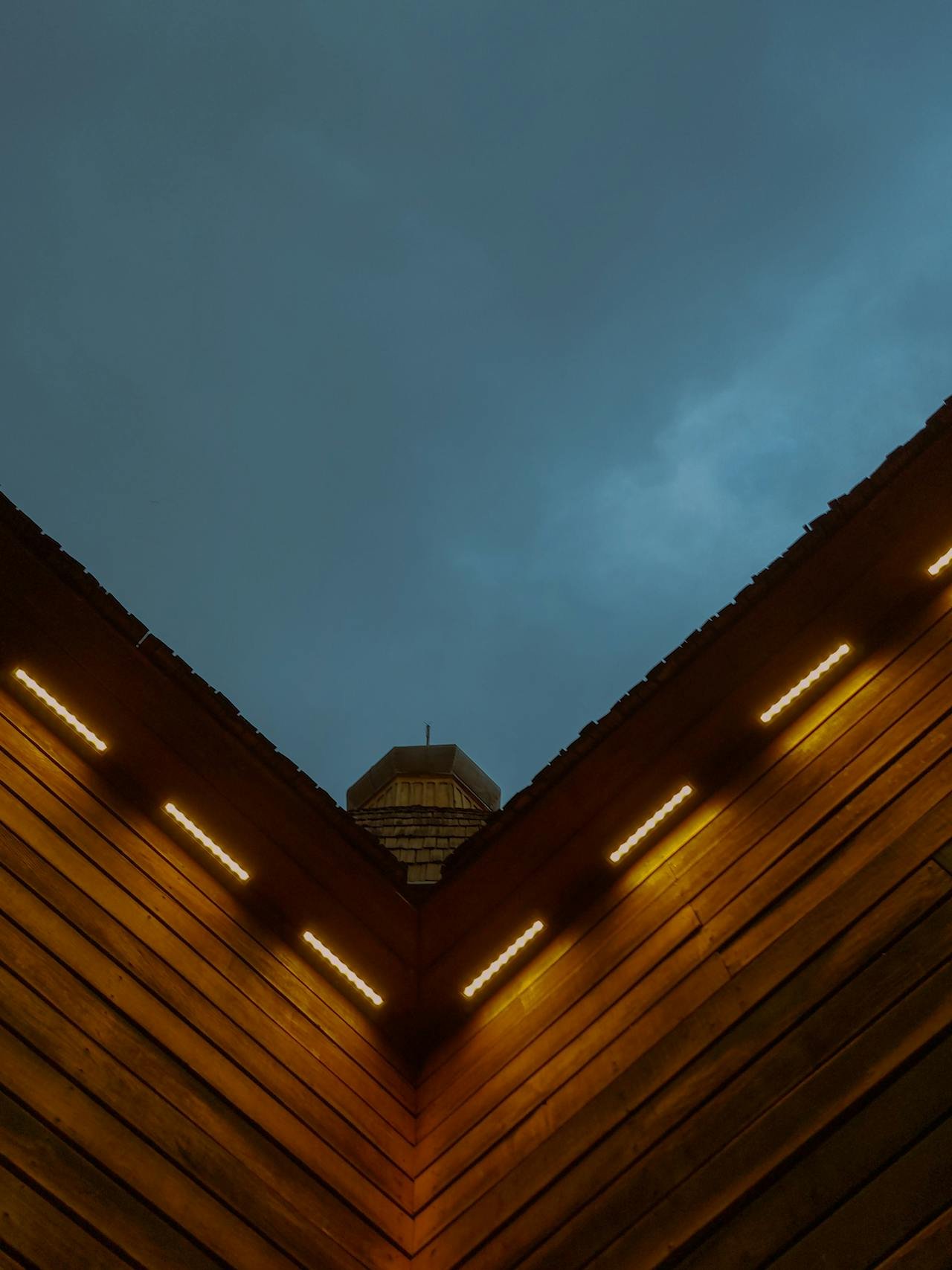
Downlighting is one of the most restrained and versatile approaches to garden lighting. In short, fixtures mounted at height direct light downward to illuminate paths, planting, terraces and structures from above rather than below. The effect is closer to natural light than almost any other lighting technique, which is precisely why it tends to age so well.
In this article, we'll explore how downlighting works in a garden context, the main fixture types and their applications, how to position downlights effectively, and how to integrate the approach into a wider lighting scheme.
What downlighting is and why it works
The appeal of downlighting lies in its restraint. Light cast from above reads as natural to the eye because it mimics the behaviour of daylight and moonlight. Shadows fall downward and away from the source. Surfaces are illuminated from above, as we're accustomed to seeing them. The result is a garden that feels calm and considered after dark rather than theatrical or overlit.
This is in direct contrast to uplighting, which casts light upward from ground level to dramatise a tree, wall or architectural feature. Uplighting has its place, but it creates an artificial effect that reads clearly as designed.
Used well, downlighting can be almost invisible as a technique. Visitors notice the illuminated garden, not the lighting. For high-end residential gardens where the goal is a space that feels genuinely liveable rather than staged, that quality is worth seeking.
Downlighting is also one of the more ecologically responsible lighting approaches. Light directed downward stays where it's intended, reducing the light scatter and sky glow associated with fixtures that emit in multiple directions.
For gardens designed with wildlife in mind, this matters. Artificial light at night disrupts insect behaviour, bat foraging routes and bird activity, and fixtures that minimise scatter reduce that impact.
Fixture types and their applications
Downlighting fixtures vary considerably in their mounting position, beam angle and output. The right choice depends on what's being illuminated and from what height.
Tree-mounted downlights
Tree-mounted downlights are among the most effective applications of the technique. A fixture secured to a branch or trunk at three to five metres height casts a wide pool of soft light below, recreating something close to the effect of moonlight filtering through a canopy.
On a terrace or lawn, this kind of illumination is far less intrusive than ground-level or wall-mounted alternatives, and the dappled shadow patterns cast by foliage add genuine character. The fixture itself disappears into the tree, so what remains is the light.
Overhead structure downlights
Overhead structure downlights are recessed or surface-mounted into pergolas, oak frames, covered walkways and garden buildings. They provide functional illumination for outdoor dining and seating areas while keeping the fixture low-profile. Recessed versions in particular are almost invisible during the day and read as part of the structure rather than as added equipment.
For a garden building or pergola that's intended to be used into the evening, this is usually the most architecturally coherent solution.
Wall-mounted downlights
Wall-mounted downlights are fixed to walls, gate piers, columns or fences and direct light downward onto paths, steps or planting at their base. They're useful for marking routes through a garden and for illuminating changes in level where safety matters. The best versions have a tight downward beam that pools light cleanly at foot level without spilling upward onto walls or into neighbouring properties.
Bollard lights
Bollard lights sit at low height, typically between 400mm and 900mm, and distribute light downward and outward at a low angle. They're well suited to wide paths and open areas where a wall or structure isn't available as a mounting point. Their presence is more visible than the other types since the fixture itself is at eye level when seated, so form and material matter. A bollard that reads as a considered garden object is very different from one that reads as car park furniture!
Positioning: where downlights work hardest
Effective downlighting depends as much on positioning as on fixture choice. A few principles apply consistently across garden types and sizes.
Level changes
Steps and level changes are the highest-priority locations for downlighting in most gardens. A poorly lit step is a safety hazard, while a well-lit one reads as a considered design detail.
Wall-mounted fixtures or fixtures integrated into the riser or adjacent wall at low level provide clear visibility without glare. The goal is to illuminate the tread and the edge of each step without flooding the surrounding area.
Paths
Paths benefit from downlighting spaced at intervals rather than continuous illumination. Pools of light separated by stretches of relative darkness create rhythm and draw the eye forward through the garden. Continuous illumination along a path can feel institutional: the aim is movement and atmosphere, not floodlit visibility.
For a path through planting, low-level fixtures mounted on short stakes or integrated into adjacent structures keep the light at the right height without requiring a wall or overhead structure.
Seating areas
Terrace and seating areas need enough light for practical use without creating the flat, shadowless brightness of indoor lighting transplanted outside. A combination of tree-mounted or overhead structure downlights, kept to a warm colour temperature, typically achieves this.
The key is to avoid placing fixtures directly overhead at close range, which creates harsh downward shadows on faces. Fixtures set back at a slight angle, or distributed across multiple mounting points at height, give a more diffuse and flattering result.
Planting
When illuminated from above, planting reads very differently to the same plants lit from below. Tree-mounted downlights cast the upper canopy into light and let lower growth remain in softer shadow. Border planting beneath overhead structures catches directional light that picks out texture and form without the theatrical quality of uplighting. For gardens where naturalism is the design intention, this approach tends to feel more coherent.
Colour temperature and control
Colour temperature has a significant effect on how a garden looks at night. Measured in Kelvin, it describes the warmth or coolness of a light source. For garden downlighting, a colour temperature between 2700K and 3000K is almost always the right choice. This range produces a warm white light that reads naturally against stone, timber, foliage and skin tone.
Cooler temperatures above 4000K produce a bluer light, which tends to make a garden feel clinical and work against the sense of warmth and enclosure that good evening lighting creates.
Dimming capability is worth specifying from the outset rather than adding later. A terrace that needs practical brightness for an outdoor dinner requires a different light level to the same space used for quiet evening use. A lighting scheme that can't be adjusted forces a compromise between the two.
Smart lighting systems allow zones to be controlled independently and programmed to different scenes, which is particularly useful in larger gardens where the dining terrace, the kitchen garden and the main lawn might all need different treatment at different times.
Integrating downlighting into a wider scheme
Downlighting works best as part of a coherent lighting scheme rather than in isolation. Most well-considered garden lighting schemes combine two or three techniques, such as:
Downlighting for the primary ambient illumination of paths, terraces and seating areas
A small amount of uplighting or grazing light for specific features where a degree of drama is appropriate
Subtle lighting within planting for depth and interest at lower levels
The risk with any lighting scheme is over-specification. Too many fixtures, each doing something slightly different, produce visual noise rather than atmosphere.
Related reading: Balance: Why Every Garden Needs Visual Equilibrium
Downlighting is a useful discipline in this respect. Its inherent restraint tends to encourage a more minimal approach overall, which is usually the right one. A garden that's gently and selectively lit feels like an extension of the house in the evening. On the other hand, a garden that's lit from every angle looks like a display.
Cable routes, junction boxes and transformer locations should all be considered during the design and build phase, before hard landscaping is laid and planting is established. Retrofitting lighting into a completed garden almost always involves compromise. Think cables running visibly along walls, fixtures positioned where access was available rather than where the light is needed, or groundworks that disturb established planting. Designing the lighting infrastructure in from the start, even if some fixtures are added later, avoids these problems.
You can learn about more gardening terminology in our complete guide.
Ready to think about lighting your garden properly?
Downlighting is one of the most enduring approaches to garden illumination: understated, ecologically considered and designed to make a garden feel liveable rather than theatrical after dark.
At Umber Garden Design, lighting is considered as part of the design process from the outset, with cable routes, mounting positions and transformer locations built into the construction drawings before groundwork begins. Our in-house team carries the work through from design to installation, so nothing is lost between specification and build.
Whether you're planning a new garden from scratch or looking to add a considered lighting scheme to an existing space, we'd be glad to discuss what's possible. Contact us today to arrange a consultation with Mark.