
After Dark: The Secrets to Garden Lighting That Works
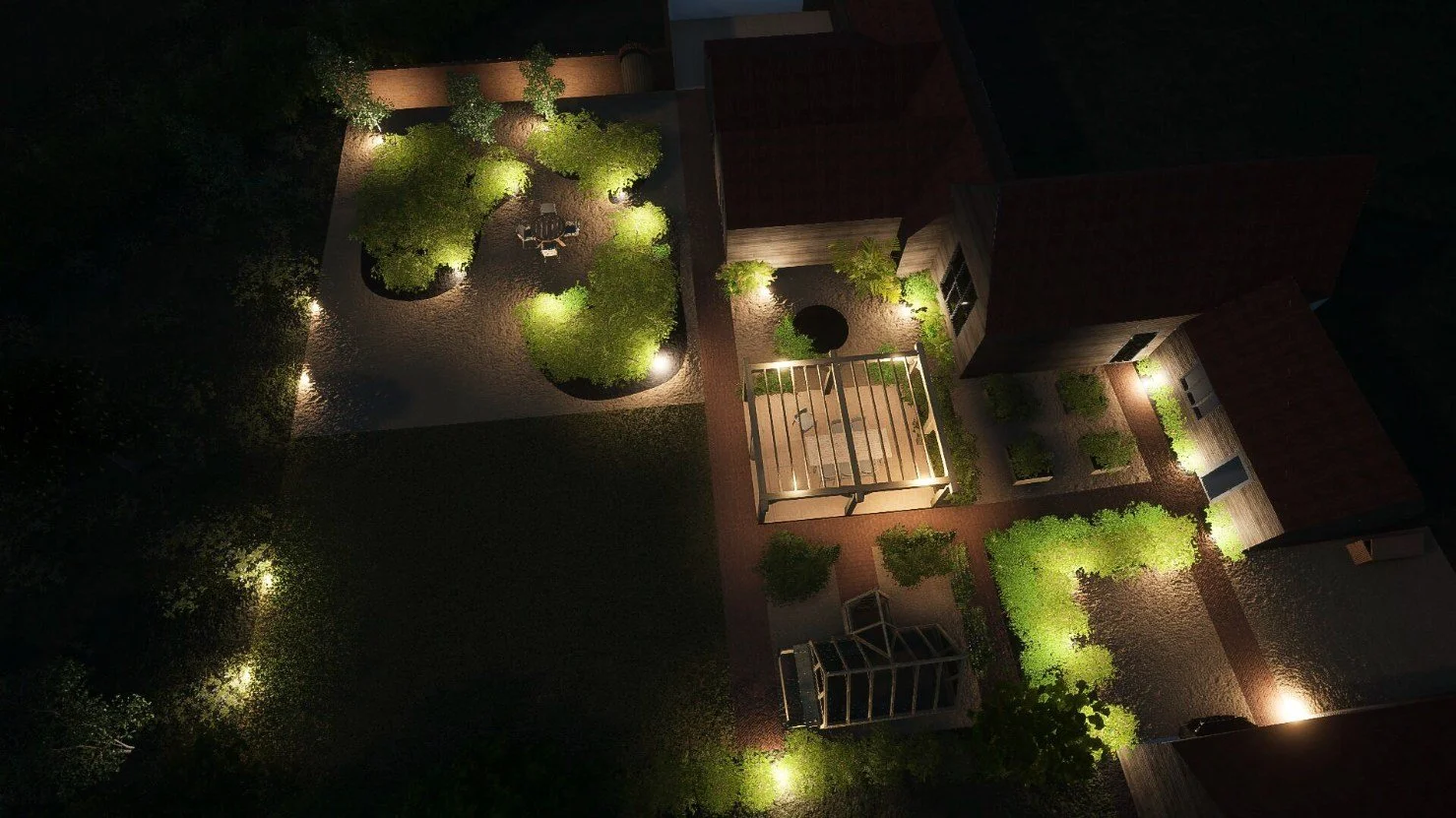
Garden lighting is outdoor lighting designed to make a garden safe and usable after dark, as well as attractive. Done well, it extends the hours you can enjoy the garden and turns the view from the house into something worth looking at on a winter evening.
Good lighting is rarely about brightness. You just need the right amount of light in the right places, with the rest in shadow. In this article, we'll explore the purposes garden lighting serves, how layering works, the fittings and colour of light to choose and how to plan a scheme that lasts.
The three purposes of garden lighting
Safety and access
The first job of any scheme is to help people move around without tripping. Steps, changes of level, paths and entrances all need enough light to read clearly. Low-level step lights recessed into walls or risers do this without shining into anyone's eyes, and they're far more comfortable than a single security light mounted high on the house.
Ambience
Soft, indirect light around terraces and seating areas makes a garden feel welcoming in the evening. The aim is a gentle glow rather than a lit stage. Light bounced off a wall, a hedge or the underside of a pergola creates a calm atmosphere for dining and relaxing outdoors.
Highlighting features
Lighting can pick out the best elements of a garden: a specimen tree, a sculpture, textured stonework or a water feature. These points of light give the eye somewhere to rest and add depth, so the garden doesn't simply stop at the edge of the terrace.
Related: A Place to Land: Why Every Garden Needs a Moment of Focus
Layering light
The most effective schemes combine several techniques at low intensity rather than relying on one powerful source. A floodlight flattens everything it touches and leaves the rest of the garden in deep shadow. Layered lighting builds a balanced picture with gentle contrast between light and dark.
Uplighting places a fitting at ground level to shine up into a tree canopy or onto a wall, emphasising height and form.
Downlighting does the reverse, with fittings mounted high in trees or on buildings to cast a soft pool of light below, often with the dappled shadow of leaves.
Grazing places a light close to a textured surface, such as a drystone wall or a hedge, so that every stone or leaf is picked out.
Silhouetting lights the surface behind a plant or object so it reads as a dark outline against a bright backdrop.
Not every feature needs lighting. Leaving some areas dark is what gives the lit elements their impact, and it helps the garden feel larger at night than it does by day.
Choosing fittings and colour of light
Colour temperature (measured in kelvin) has a significant effect on how a garden looks at night. Warm white light of around 2700K to 3000K flatters stone, timber and most planting, and it feels comfortable to sit in. Cooler, bluer light can work on silver foliage or water but tends to look harsh across a whole garden.
Fittings should be built for outdoor use. Look for a rating of at least IP65, which means the fitting is sealed against dust and water jets, and IP68 for anything buried or submerged. Solid brass, copper and bronze fittings weather to a natural finish and last far longer than painted or plastic alternatives. In most cases, the fitting itself should be discreet or hidden, so you see the effect of the light rather than the source.
LED lamps are now the standard choice. They use little energy, produce minimal heat and can run for many years before needing replacement.
Power, controls and installation
Garden lighting runs either on mains voltage or on a low-voltage system, typically 12V or 24V, supplied through a transformer. Low-voltage systems are easier to adjust and safer around water, while mains fittings suit longer cable runs and higher outputs. Either way, outdoor electrical work should be carried out by a qualified electrician, with suitable armoured or protected cable and RCD protection, and in line with Building Regulations.
Controls make a scheme far more usable. Dividing the lighting into separate circuits lets you light the terrace for dinner without switching on the whole garden. Timers, dusk sensors and smart controls can bring lights on automatically and turn them off at a set hour, which saves energy and avoids lighting the garden through the night.
Planning lighting into a garden design
Lighting is far easier and cheaper to install while a garden is being built than once it's complete. Ducting can be laid beneath paths and terraces during construction, so cables can be pulled through later without lifting paving or disturbing mature planting. Allowing spare capacity also means fittings can be added as trees grow and the garden matures.
A considered scheme also respects the night. Keeping light low, aimed downwards or at specific features, and switched off late in the evening reduces light pollution. It also limits disruption to bats, moths and other nocturnal wildlife. In rural parts of Warwickshire, where dark skies are part of a property's appeal, restraint is often what makes a lighting scheme feel right.
You can learn about more gardening terminology in our complete guide.
Ready to bring your garden to life after dark?
Well-designed lighting makes a garden safer, more usable and more rewarding to look at long after sunset. At Umber Garden Design, we plan lighting as part of every garden design and landscaping project, so cabling, fittings and controls are built in from the start rather than added as an afterthought. We'll work closely with you to light the features and spaces that matter most and leave the rest to the dark.
Whether you're planning a new garden or adding lighting to an established one, we'll make sure the scheme suits the way you use your outdoor space. Contact us today on 01926 754 049 or at hello@umbergardendesign.co.uk to arrange a consultation.