
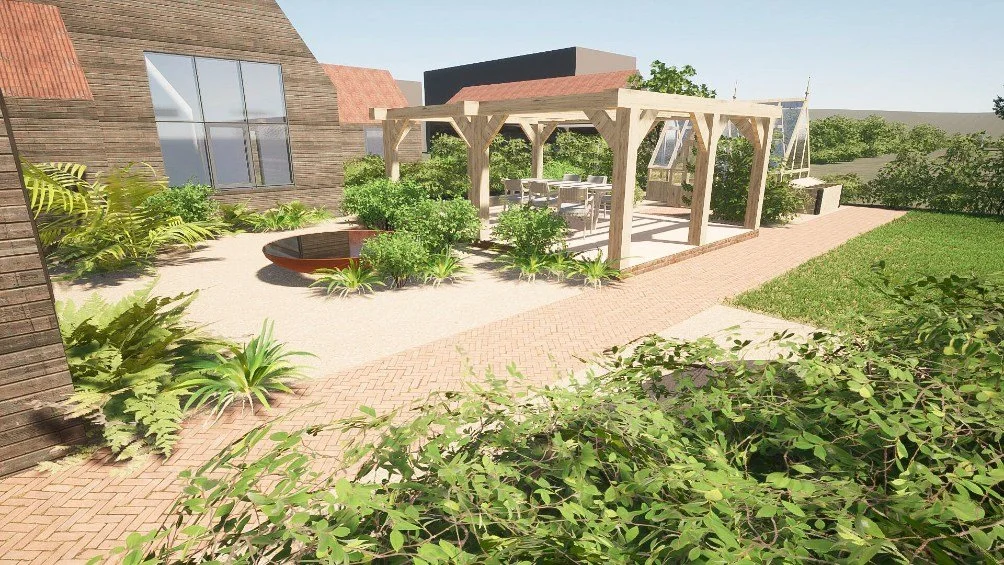
A fire pit is an outdoor fire feature that provides warmth and light, plus a natural focal point for any gathering. It's one of the simplest ways to make a garden usable on cool evenings, well beyond the summer months.
Getting a fire pit right involves more than choosing a bowl and lighting it. In this article, we'll explore the difference between built-in and freestanding designs and the main fuel options. You’ll also learn where to position a fire pit safely and how to design the space around it.
What a fire pit adds to a garden
A fire pit gives a garden a social centre. People naturally gather around a fire, and the circle of seating it creates encourages conversation in a way that a row of chairs on a terrace doesn't. After dark, it becomes the focal point of the garden, drawing the eye and anchoring the space.
It also stretches the outdoor season. With a fire pit, a spring evening or a crisp autumn night becomes a reason to stay outside rather than retreat indoors. For households that entertain, it often becomes the most-used feature after the main dining area.
Built-in and freestanding fire pits
Freestanding
Freestanding fire pits are portable bowls or braziers, usually made from steel, cast iron or Corten. They're quick to install and can be moved with the seasons. They're also a good way to test how often a fire pit will be used before committing to something permanent.
Built in
Built-in fire pits are constructed as part of the hard landscaping, typically in stone, brick or rendered blockwork with a fire-resistant lining. They feel more considered and permanent, and they can be designed to match the walls and paving elsewhere in the garden. A built-in pit is often set within a sunken seating area or surrounded by low walls that double as benches.
Choosing a fuel
Here’s a quick rundown of the three fuel options...
Wood
Wood gives the classic fire pit experience, with crackling flames, real heat and the smell of woodsmoke. It does produce smoke and sparks though, so it needs more space and more care with positioning.
Gas
Gas fire pits run on mains gas or bottled LPG and light at the turn of a switch. They produce a steady flame with no smoke or ash, which makes them easier to place close to the house. A mains supply must be installed by a Gas Safe registered engineer, and LPG bottles need a ventilated, discreet housing.
Bioethanol
Bioethanol burners use a liquid fuel that burns cleanly without smoke or ash. They suit smaller gardens and contemporary schemes, but they give out less heat than wood or gas. They're best thought of as an atmospheric feature rather than a main source of warmth.
Siting and safety
Position is the most important decision. As a general guide, a wood-burning fire pit should sit at least 3m from the house, fences, sheds and overhanging branches. Gas and bioethanol fire pits can usually be placed closer, but the manufacturer's guidance should always be followed.
The ground beneath matters too. A fire pit should sit on a non-combustible surface such as stone, brick or gravel, and never directly on decking unless the product is specifically designed for it. Gravel is a popular choice, as it's affordable and drains freely. It also suits the informal character of most fire pit areas.
It's worth thinking about wind and neighbours too. Smoke drifting towards the house or over a boundary will quickly become a problem, so a wood-burning pit is best placed where the prevailing wind carries smoke away.
Designing the space around it
The best fire pit areas feel like a destination. Placing the fire pit slightly away from the house or within its own garden room gives people a reason to walk out into the garden in the evening.
Seating should form a loose circle, with enough room to sit comfortably without getting too hot. Built-in benches or low walls work well, and cushions and throws make the space usable on colder nights. As a rough guide, a seating area around 4m to 5m across suits a fire pit for six to eight people.
Planting helps the area feel enclosed and sheltered. Evergreen shrubs and hedging provide year-round screening, while ornamental grasses catch the firelight as they move. Any planting should be kept a safe distance from the flames. Low-level lighting along paths and steps keeps the route back to the house safe after dark.
A fire pit through the seasons
A fire pit earns its place across most of the year. It comes into its own in spring and autumn, when evenings are cool but still inviting. And it's just as welcome on clear winter nights.
In summer, many fire pits double as a cooking feature, with grill plates or swing-arm grills that complement an outdoor kitchen.
Upkeep is simple. Wood-burning pits need regular ash clearing and good drainage so that rainwater doesn't collect in the bowl. A fitted cover protects gas burners and keeps debris out when the fire pit isn't in use.
You can learn about more gardening terminology in our complete guide.
Add the right fire pit to your garden
A well-designed fire pit gives your garden a natural gathering point and extends its use long into the evening. At Umber Garden Design, we design fire pit areas as part of our wider garden design and landscaping work, placing them where they're safe and well used.
Whether you'd like a simple freestanding bowl on gravel or a built-in fire pit with surrounding seating, we'll design a space that suits your garden. Contact us today on 01926 754 049 or at hello@umbergardendesign.co.uk to talk through your ideas.