
Say Less: The Principles Behind a Minimalist Garden
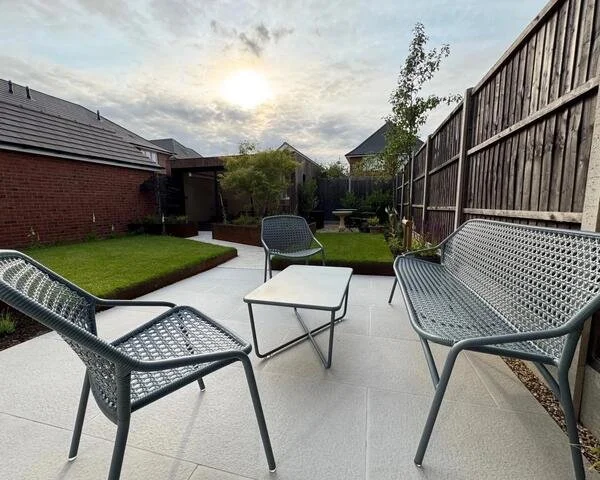
Minimalism in garden design means working with a reduced palette of materials and plants. It’s deliberately restrained rather than simply sparse. Every material, plant and structural element earns its place, and nothing is included purely for decoration.
In this article, we'll explore what sets a minimalist garden apart from an empty one and where the style draws its influence from. We’ll also discuss how to choose a restrained material palette and how planting works within that framework.
What minimalism means in garden design
Minimalism is frequently mistaken for a lack of planting or a lack of ambition, when it's really the opposite. A minimalist garden asks more of every element it includes, since there's nowhere for a poorly chosen material or an awkward proportion to hide. Fewer materials and a tighter plant palette mean each decision carries more visual weight than it would in a densely layered, eclectic garden.
There’s no absence of ideas though. The restraint is deliberate. A minimalist garden is edited in a sense. So, elements that don't contribute to the overall composition are removed. What remains is chosen with unusual precision, in terms of colour, texture, proportion and how it relates to everything around it.
The origins of minimalist garden design
Minimalist landscape design draws heavily on two traditions:
Japanese Zen gardens – With their restrained use of stone, gravel and carefully placed planting, they established the principle that empty space can be as expressive as filled space centuries before the term "minimalism" existed.
Western gardens – Working alongside the clean lines of modernist buildings, mid-century modernist landscape architects applied similar restraint to Western gardens. Think geometric forms, a limited material palette and planting chosen for structure rather than variety.
Both traditions share the underlying idea that a garden doesn't need abundance to feel complete. Careful proportion, negative space and repetition can create a sense of calm and coherence that a busier design often struggles to achieve.
Choosing a restrained material palette
A minimalist garden typically limits itself to two or three materials used consistently throughout. There’s no need to introduce a new material for every element. A single paving material might extend from a patio into a path, with the same stone or a closely related tone used for any walling or steps. The result? The whole space reads as one considered composition rather than a collection of separate decisions.
Consistency matters more than any individual material choice. Large format paving, poured concrete and natural stone in a limited colour range are common choices. They’re selected as much for how well they age and how little they compete visually with planting as for their appearance on installation day.
Planting within a minimalist framework
Minimalist planting favours structure and repetition over variety. Rather than a wide mix of species chosen for successive seasonal interest, a minimalist garden often works with a small number of plants used in bold, repeated blocks. For example:
A single ornamental grass running the length of a border
One evergreen species clipped into consistent forms
A handful of architectural perennials repeated at intervals
This restraint doesn't mean the planting lacks seasonal change. Grasses and structural perennials still move through the year, from summer growth to winter seed heads. But the limited palette keeps that change legible rather than chaotic. A single species repeated at scale often reads as more considered than a dozen different plants competing for attention in the same space.
Getting the proportions right
Minimalist design lives or dies on proportion. Without a wide variety of materials or planting to soften an awkward layout, poor spacing becomes immediately obvious. The same is true for an ill-fitting ratio of hard surface to planting, or a badly positioned structural feature. Getting the underlying geometry right at the design stage matters more here than in almost any other garden style.
Negative space does real work in a minimalist scheme. That’s the gravel, lawn or paving left deliberately open between planted areas. It gives the eye somewhere to rest and lets the limited planting and material palette read clearly, rather than competing for attention across every part of the garden.
You can learn about more gardening terminology in our complete guide.
Ready to design a garden built on restraint?
A minimalist garden offers calm, coherence and a sense of quality that comes from precision rather than abundance. At Umber Garden Design, we bring the same attention to proportion and material consistency to minimalist schemes as we do to any other style within our garden design and landscaping services.
Whether you're drawn to a fully restrained material palette or want to bring some of these principles into a more traditional garden, we'll work closely with you to get the proportions and materials right from the outset. Contact us today to arrange a consultation.